AI Search Doesn’t Reward the Best Nonprofits. It Rewards the Best-Documented Ones.
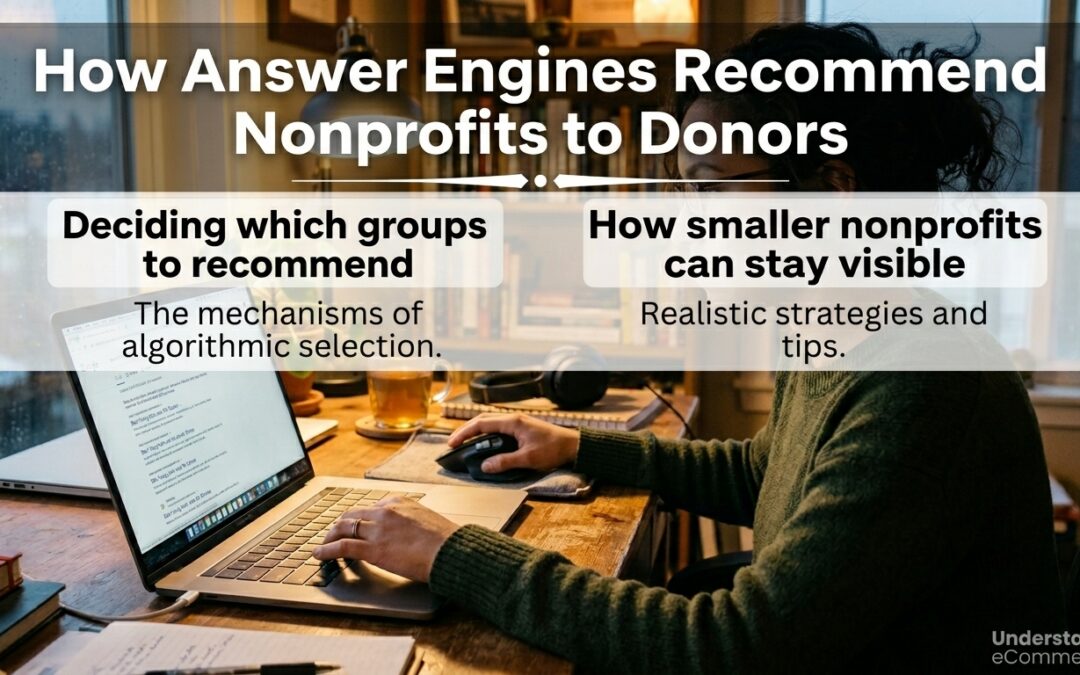
How answer engines decide which nonprofits get recommended to donors, and what smaller organizations can realistically do to stay visible.
A donor types a question into ChatGPT or a Google AI Overview instead of a search bar: “food banks near me that also do home delivery” or “youth mentoring nonprofits with a strong volunteer track record.” The AI reads across the web, picks a handful of organizations, and answers in a paragraph. Your nonprofit either shows up in that paragraph or it doesn’t. There’s no page two to scroll to.
That shift is real, and it changes what “getting found” means for a nonprofit. The instinct most organizations rely on no longer works.
Why the common approach fails
Most nonprofit websites are built to be read by a person clicking around, not by a system pulling out an answer. That mismatch is the whole problem.
A typical “About Us” page opens with mission language and history before it ever states, in plain terms, what the organization does and who it serves. An AI system skimming for an answer to “which nonprofits deliver groceries to homebound seniors” has to dig for that sentence, and it often just moves to the next site instead.
Most sites also compete for broad terms like “food bank,” “youth mentoring,” or “environmental nonprofit.” A donor’s actual question is much narrower: which one serves this specific neighborhood, offers this specific program, or has this specific track record. Broad keywords made sense under old-style search rankings. A system trying to match a narrow question to a narrow answer is of little use to them.
Most nonprofits still treat their own website as the only source that matters. An AI system checks other trusted sources too: local news coverage, GuideStar or Charity Navigator listings, community forums. It looks for those sources to corroborate what your site claims about itself. Skip that step, and a polished site with no external mentions can end up looking, to an AI system, much like an organization that barely exists.
A repeatable framework
Four changes make a nonprofit’s content easier for an AI system to find, trust, and recommend.
Answer first, story second. Open each program or services page with a direct, plain-language answer to the question a donor or client would actually ask, in the first sentence or two. Save the mission narrative for after that answer.
Use structured data. Add schema markup for your organization’s name, location, service area, and program details. This is invisible code that translates your site into a format machines can read directly, so a system doesn’t have to guess at what your page is describing.
Target the specific question. Build pages around narrow, real donor and client questions, like “does this org serve rural counties?” or “is this program free for families under a certain income,” instead of competing for the broadest possible category term.
Earn mentions elsewhere. Show up in local press, nonprofit directories, and community discussions in ways an AI system can cross-check. Consistency between what you say about yourself and what others say about you builds the kind of credibility these systems weigh.
A realistic example
A mid-sized youth-mentoring nonprofit rewrites its main program page. The old version opened with two paragraphs about the founder’s story before mentioning what the program does. The new version opens with a single sentence that states exactly what the program is, who it serves, and where it operates, followed by the founder’s story further down the page.
The organization adds schema markup listing its service area and program type. It identifies three local outlets that covered its work in the past two years and reaches out about an upcoming roundup of local youth programs. It also updates its GuideStar profile so the numbers there match what’s on its own site.
This doesn’t guarantee a spot in an AI-generated answer. It removes the reasons an AI system would have skipped the organization entirely, which is the realistic bar to clear.
The limitation worth naming
This approach has a real equity problem. Schema markup, ongoing content rewrites, and active outreach to press and directories take staff time, technical skill, or budget for outside help, resources a small, community-rooted nonprofit is far less likely to have than a large, well-funded one. The organizations best positioned to optimize for AI search are often not the organizations doing the most direct, on-the-ground work.
There’s a second layer to this. AI systems learn what’s trustworthy partly from what’s already well-documented online. A nonprofit serving a community with less digital infrastructure, less local press coverage, and fewer online reviews will have a thinner footprint to draw on, no matter how good its programs are. Optimizing for AI search can end up amplifying organizations that were already visible rather than surfacing the ones doing work that most needs to be found.
These changes are still worth making. Treat AI visibility as one input into how donors find you. It works alongside the community relationships and referral networks that already reach the people traditional search and AI search both tend to miss, not in place of them.
One next action
Pick your organization’s single most important program page and run this prompt against it in an AI assistant:
“Here is my nonprofit’s program page: [paste the text]. If someone asked an AI search assistant a specific question about who we serve and what we offer, would this page give a system enough to answer clearly and confidently in the first two sentences? Rewrite the opening to lead with a direct answer, and tell me what’s missing that a donor or a search system would need to trust the page.”
Follow us on LinkedIn – Build, Grow, Convert.

About Mike Doherty
Mike Doherty serves as Chief Experience Officer at Greening Projects, a nonprofit organization dedicated to transforming underutilized urban spaces into vibrant green areas that benefit communities and the environment. With a passion for urban revitalization and community-centered approaches, Mike oversees the end-to-end experience of residents, volunteers, municipal partners, and donors involved in the organization’s green space conversion projects. His role encompasses strategic vision, community engagement, and ensuring that every interaction reflects Greening Projects’ commitment to creating accessible, sustainable urban oases. Under his leadership, the experienced team focuses on making green space development collaborative, impactful, and meaningful for all stakeholders while fostering stronger, healthier neighborhoods through environmental transformation.