How Do I Write for AI Search Optimization?
AI Search Optimization (AISO), also referred to as Generative Engine Optimization (GEO), is the process of fine-tuning digital content so that artificial intelligence models and “Answer Engines”, such as ChatGPT, Claude, and Google AI Overviews, can easily find, understand, and recommend your business.
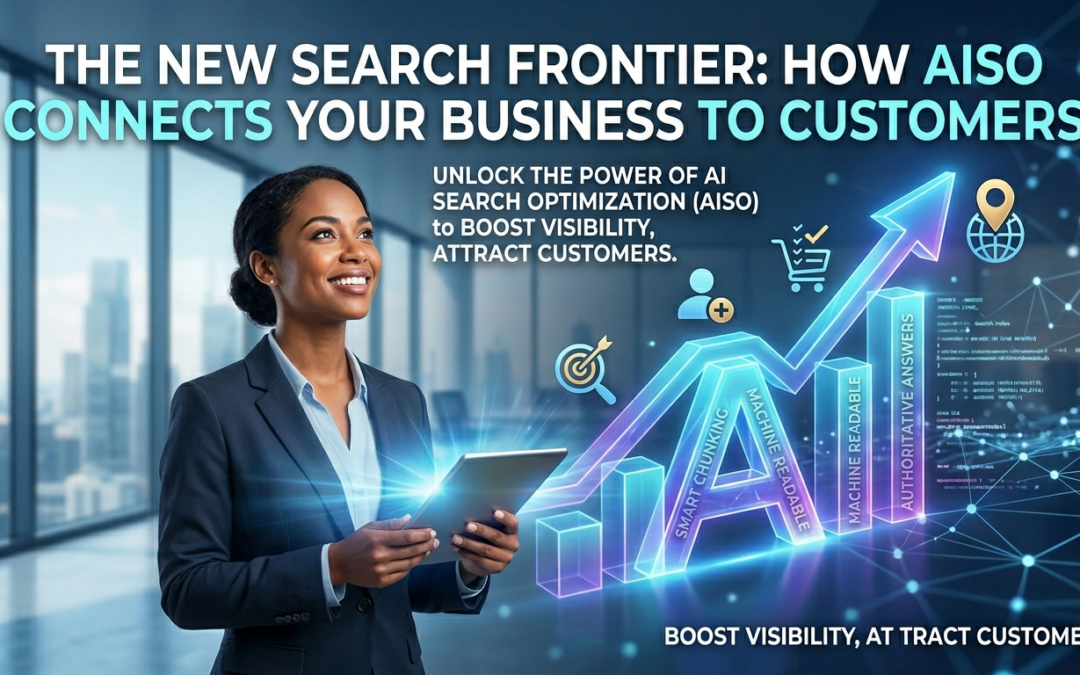
The New Search Frontier: How AISO Connects Your Business to Customers
The search landscape is undergoing its most significant shift in twenty years, moving from a list of links to a direct “Answer Engine” model. While traditional SEO is still relevant, the rise of AI assistants like ChatGPT and Google AI Overviews has introduced a new discipline: AI Search Optimization (AISO). This strategy focuses on making your business information so clear, structured, and authoritative that AI models choose to cite you as the primary answer to a user’s query. By organizing your digital presence into machine-friendly “chunks” of data, you ensure that when a customer asks a complex question, your business is the one the AI recommends.
Frequently Asked Questions
What is the main difference between SEO and AISO?
Traditional SEO focuses on ranking your website in the top ten search results for specific keywords. AISO (or Generative Engine Optimization) focuses on getting your brand cited as the definitive answer within an AI-generated summary. While SEO targets clicks, AISO targets being the “trusted source” for conversational assistants.
How does “chunking” help my business show up in AI search?
AI models do not read long pages the same way humans do; they break content into small fragments or “chunks.” By using an answer-first structure, placing the most important information in the first two sentences of a section, you make it easier for the AI to extract and use your data in its responses.
Why is Schema Markup important for AI?
Schema Markup is a type of machine-readable code that acts as a direct handshake with AI bots. It translates your text into a structured format that tells the AI exactly what your services, prices, and locations are, reducing the risk of misinterpretation.
Will AI search make my website traffic disappear?
Not necessarily, but it will change the type of traffic you receive. AI search often handles “top-of-funnel” research questions directly. This means the users who do click through to your site are often further along in their buying journey and more likely to convert into customers, as the AI has already “pre-vetted” your business for them.
How do I prove to an AI that my business is trustworthy?
AI engines verify your claims by looking for your business name across the web on third-party platforms. Consistent mentions in industry news, active discussions on community forums like Reddit, and positive reviews on local directories help build the “co-occurrence” and authority that AI models require before citing you.
While traditional SEO focuses on getting a website to rank in search results, AISO focuses on ensuring your information is the primary source an AI uses to generate a conversational response.
Key Differences Between AISO and SEO
The transition from SEO to AISO represents a fundamental shift from “ranking” to “answering.”
- Primary Goal: Traditional SEO aims to rank in the top 10 search results. AISO aims to become the cited source in an AI-generated answer.
- Content Structure: SEO often utilizes keyword-optimized long-form articles. AISO prioritizes modular, “snippable” blocks of high-density facts.
- Success Metrics: SEO is measured by click-through rates and page views. AISO is measured by brand mentions and inclusion in AI summaries.
- User Intent: SEO matches specific keywords (e.g., “best pizza”). AISO solves complex, multi-step queries (e.g., “best pizza for a gluten-free group near the park”).Authority: SEO relies on backlinks and domain authority. AISO relies on brand “co-occurrence” and verifiable facts across multiple trusted platforms.
How AISO Changes the Strategy
- From Keywords to Context: AI seeks the most comprehensive and trustworthy answer to a user’s problem rather than just a single word.
- The Power of Chunking: AI models break content into small knowledge fragments. To perform well, writing must be direct, often placing the most important answer in the first two sentences.
- Structured Data Reliance: AISO relies heavily on Schema Markup, which acts as a machine-readable “handshake” that tells the AI exactly what your business does.
- Off-Site Verification: AI cross-references claims. If your business is mentioned on Reddit, industry news sites, and local directories, the AI is more likely to trust and cite you.
Follow us on LinkedIn – Build, Grow, Convert.

About Mike Doherty
Mike Doherty serves as Chief Experience Officer at Greening Projects, a nonprofit organization dedicated to transforming underutilized urban spaces into vibrant green areas that benefit communities and the environment. With a passion for urban revitalization and community-centered approaches, Mike oversees the end-to-end experience of residents, volunteers, municipal partners, and donors involved in the organization’s green space conversion projects. His role encompasses strategic vision, community engagement, and ensuring that every interaction reflects Greening Projects’ commitment to creating accessible, sustainable urban oases. Under his leadership, the experienced team focuses on making green space development collaborative, impactful, and meaningful for all stakeholders while fostering stronger, healthier neighborhoods through environmental transformation.