The 5-Mile Radius Principle for Local Business Growth
Why broad-reach marketing wastes the budget your neighborhood already wants to give you
Most local business owners are handed the same marketing playbook the moment they open their doors: build a website, run some social ads, chase broader reach, and hope the algorithm finds the right people somewhere out there. It’s the default because it’s what nearly every digital marketing tool is built to sell, and it isn’t wrong exactly. It’s just aimed at the wrong radius. A boutique or a neighborhood clinic competing for attention across an entire metro area is spending money to reach thousands of people who will never walk through its door, while the handful of streets that actually produce loyal, repeat customers get almost no dedicated attention at all.
The 5-Mile Radius Principle names what gets lost in that broad-reach approach. It holds that the most valuable, loyal, and cost-effective customers for a brick-and-mortar business typically live or work within about five miles of the storefront. Digital marketing can technically reach anyone on earth, but proximity does something a national or online-only competitor can’t easily copy. It builds a kind of moat made of habit, familiarity, and geography rather than ad spend, and chasing broad reach instead of that moat is why so much local marketing budget produces so little loyalty.
The numbers behind this are hard to argue with. Roughly 78% of local searches lead to an in-store visit within 24 hours, so the gap between someone discovering a business and walking through its door is often measured in hours. A repeat local customer is about five times more likely to return than someone visiting from farther away. And the typical distance people are willing to travel for routine, everyday services tends to top out around three miles, whether that’s a haircut, a dry cleaner, or a plate of food at the restaurant down the street. Distance predicts loyalty better than almost anything else a business can measure.
Why proximity beats reach
Part of the effect is simple exposure. Someone who walks or drives past a storefront several times a week builds a familiarity that no ad campaign buys at the same price, and that repetition creates trust before a single transaction happens. Part of it is friction, or the lack of it. When something goes wrong and a customer can walk in and sort it out in person instead of filing a complaint into a void, the cost of switching to a competitor rises without anyone having to design for that. Leaving means giving up an easy relationship, and a replaceable product is a much easier thing to walk away from than that.
There’s a less transactional layer underneath that. A local business often becomes part of a customer’s own sense of belonging to their neighborhood, a form of community identity no algorithm can simulate no matter how precisely it targets an ad. And economically, the case is just as direct: acquiring a new customer typically costs five to seven times as much as retaining an existing one, and geography is one of the strongest predictors of whether that retention actually happens.
A framework for hyper-local growth
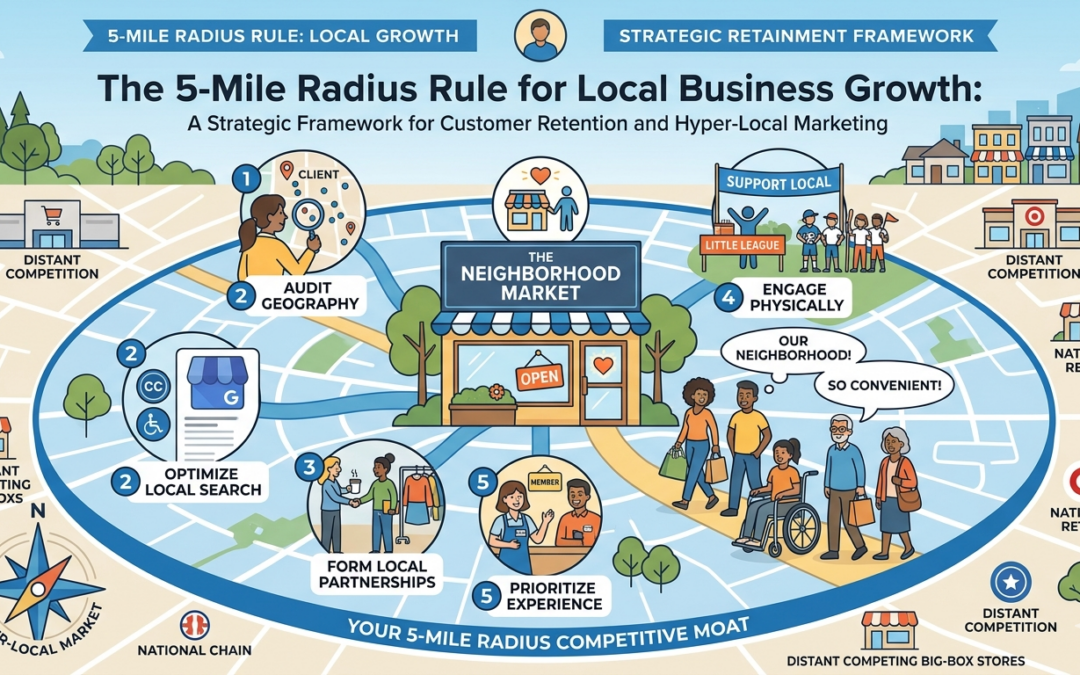
Turning this into an actual plan starts with an honest audit rather than another marketing push. Plotting current high-value customers on a real map tends to reveal something owners rarely expect on their own: a handful of specific streets or commute corridors quietly account for a disproportionate share of revenue, and that map should shape everything that follows. Local search comes next. A Google Business Profile with accurate hours and neighborhood-specific language, paired with landing pages built around a particular area rather than a generic service category, does more for local visibility than most broad digital campaigns manage.
From there, the plan moves offline. Partnering with a non-competing neighbor on the same block reaches the exact people already walking that street in a way a broad social ad rarely does. Picture a coffee shop cross-promoting with the boutique two doors down. Sponsoring a local sports team, contributing to a neighborhood newsletter, or showing up at a weekend farmers’ market embeds a brand in the rhythm of community life rather than interrupting it on a screen. And inside the business itself, every transaction is worth treating as the start of a long relationship rather than a single sale. Remembering a regular’s name or their usual order carries more weight when it comes from a neighbor than it ever would from a stranger.
What does this look like in practice?
The figures below are illustrative, not drawn from a real business.
A neighborhood bakery spends its first year running citywide social ads and boosting posts to reach as many people as possible across town. Foot traffic averages around 40 transactions a day, but fewer than 1 in 10 of those customers ever return for a second visit. Applying the framework, the owner maps a year’s worth of receipts against customer addresses and finds that roughly 70% of repeat business comes from four surrounding blocks, streets the bakery had never specifically marketed to. The ad budget shifts: half goes toward a sharper Google Business Profile and a landing page built around those specific streets, and half goes toward sponsoring a local youth soccer team and setting up a table at the neighborhood’s monthly market.
Within a few months, walk-in traffic from those four blocks noticeably increases, repeat visits climb well past that original one-in-ten rate, and staff start recognizing regulars by name. The bakery hasn’t grown its total addressable audience. It’s grown the share of a much smaller audience that actually keeps coming back, which is the entire point of the principle.
Where this breaks down
The 5-Mile Radius Principle assumes a business has a fixed physical location worth building a neighborhood identity around, and that assumption leaves some businesses out entirely. A delivery-only kitchen, a home-based service, or a business run out of a shared space has no storefront for passersby to notice and no natural five-mile community to embed itself in. Forcing the framework onto a business like that, sponsoring a sports team with no storefront to point people toward, wastes the same money it’s meant to save.
There’s a quieter equity issue for businesses that this framework doesn’t fit. Building local trust through partnerships and sponsorships works fastest when there’s already some relationship to build on. A business just entering a neighborhood starts this process from a real deficit, and that’s especially true for an owner with no built-in local network, someone new to the area or to running a business there. The five steps are the same for everyone. The time it takes to see them pay off usually isn’t long, and a newcomer without that head start needs patience that the framework doesn’t account for.
One next action
Pull the last twelve months of customer receipts or booking records, and plot each one against the address on file. Look for the radius where repeat customers actually cluster, not the radius the business has been marketing to by default. If a few nearby blocks turn out to be quietly driving most of the loyal business, that’s the map worth spending the next quarter’s budget on.
Our Newsletter – Build, Grow, Convert

About Mike Doherty
Mike Doherty serves as Chief Experience Officer at Greening Projects, a nonprofit organization dedicated to transforming underutilized urban spaces into vibrant green areas that benefit communities and the environment. With a passion for urban revitalization and community-centered approaches, Mike oversees the end-to-end experience of residents, volunteers, municipal partners, and donors involved in the organization’s green space conversion projects. His role encompasses strategic vision, community engagement, and ensuring that every interaction reflects Greening Projects’ commitment to creating accessible, sustainable urban oases. Under his leadership, the experienced team focuses on making green space development collaborative, impactful, and meaningful for all stakeholders while fostering stronger, healthier neighborhoods through environmental transformation.