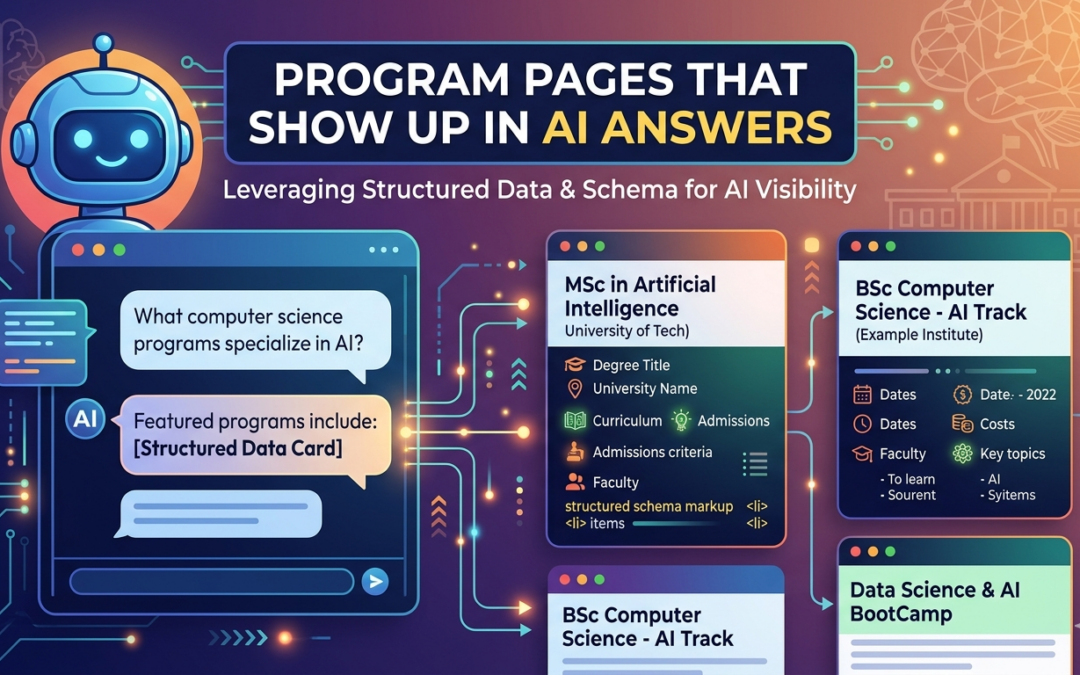
Program Pages That Show Up in AI Answers
What nonprofit leaders need to know about the new search landscape
When someone types “free tax help for seniors in [your city]” into ChatGPT or asks Perplexity, “where can I find job training for people with disabilities,” they’re not getting a list of blue links anymore. They’re getting a direct answer, built from content on websites just like yours.
The question is whether your program pages are the ones feeding those answers.
Why This Matters More Than You Think
AI tools, including ChatGPT, Perplexity, Google’s AI Overviews, and Microsoft Copilot, have become a primary discovery layer for people looking for services. For nonprofit leaders, this shift is significant. Your programs may be exactly what someone needs, but if your web pages aren’t written in a way that AI systems can read and use, you’re invisible to a growing portion of the people you exist to serve.
This isn’t about gaming algorithms. It’s about communicating clearly enough that both humans and AI can understand what you offer, who you serve, and how to connect with you.
The Core Problem With Most Program Pages
Most nonprofit program pages were written with donors, board members, or grantors in mind — not the people who actually need the service. They lead with mission language (“empowering communities through transformative workforce development”) rather than plain-language answers to the questions a person in need would actually ask.
AI systems are trying to match questions to answers. If your page doesn’t contain the answer in a recognizable form, it won’t be surfaced.
The fix is simpler than most organizations expect.
What AI Systems Are Looking For
When an AI tool scans your program page to decide whether it answers a user’s question, it’s essentially asking:
What does this program do? (in plain terms)
Who is it for? (specific eligibility)
Where and when? (location, schedule, availability)
How do people access it? (intake process, contact info)
Is this page credible and current? (dates, organization name, trust signals)
If your page answers these five questions clearly, you’re already ahead of most nonprofit websites.
Practical Guidance for Each Program Page
Lead with what, not why.
Start every program page with a one- or two-sentence plain-language description of what the program does. Save your mission framing for the second paragraph. “We provide free legal representation to tenants facing eviction in Riverside County” is more useful to an AI (and a scared renter) than “We believe everyone deserves access to justice.”
Name the population explicitly.
AI tools match based on specificity. Don’t say “vulnerable community members.” Say “adults 60 and older,” “families with children under 5,” or “people experiencing housing instability.” The more specific and plain your eligibility language is, the more precisely you’ll be matched with people searching for you.
Include location and geography clearly.
Many nonprofits serve a defined geography, but never name it on the program page. Include county names, city names, and zip codes if possible. “We serve clients throughout the Coachella Valley, including Palm Springs, Indio, Desert Hot Springs, and Cathedral City” is far more useful than “serving our local community.”
Write a short FAQ section.
AI systems love FAQ formats because they’re structured as question-and-answer pairs — exactly the format those tools are trying to construct. Add 4–6 questions your clients actually ask: Do I have to pay? Do I need an appointment? What should I bring? Is this available in Spanish? Write the answers in one to three plain sentences each.
State the program name in full, every time.
Don’t assume readers (or AI crawlers) know which page they’re on. Use the full program name in your headings, body text, and page title. If your program has an acronym, spell it out at least once.
Keep contact information on the page itself.
Don’t link to a separate contact page. Include a phone number, email, or intake link directly on each program page. AI tools that provide direct answers will pull from the page they’re reading — if the contact info isn’t there, it won’t be included.
Add a “last updated” date.
AI systems weigh freshness. If your page hasn’t been visibly updated in 3 years, it may signal potential inaccuracy. Even a small “Updated March 2025” line increases the likelihood that AI tools treat the information as reliable.
A Note on Google’s AI Overviews
When someone searches Google for services in your area, they may now see an AI-generated summary at the top of the results page before any links appear. This summary is drawn from websites Google trusts and that contain clearly structured information.
To appear in these overviews, your program pages need to rank reasonably well in standard search, but more importantly, they need to contain direct, factual, well-organized language. The same principles that help humans find and understand your programs are the ones that feed AI summaries.
The Accessibility Argument
There’s an equity dimension to this work worth naming directly.
The people most likely to use AI tools to find social services are also often the people with the least bandwidth to navigate confusing websites or make multiple phone calls. Clear, AI-readable program pages aren’t just a marketing strategy; they’re a way of making your organization more accessible to the people who need it most.
When someone asks an AI assistant for help finding food assistance or a domestic violence shelter or a literacy program, they may be in a moment of real vulnerability.
Your program page being findable and clear in that moment matters.
Where to Start
Pick your three highest-traffic or most critical program pages. For each one, run through this five-question test:
- Does the first paragraph say exactly what this program does in plain language?
- Is the target population named specifically?
- Is the geographic service area named explicitly?
- Is there a FAQ section with real questions your clients ask?
- Is the contact information on the page itself?
If any answer is no, that’s your edit. You don’t need a website overhaul. You need clearer writing on the pages that matter most.
The organizations that appear in AI answers over the next few years won’t necessarily be the largest or best-funded. They’ll be the ones that wrote plainly enough for both a search engine and a person in crisis to understand exactly what they offer.
That’s a bar your organization can clear, and it’s worth clearing.
About Mike Doherty
Mike Doherty serves as Chief Experience Officer at Greening Projects, a nonprofit organization dedicated to transforming underutilized urban spaces into vibrant green areas that benefit communities and the environment. With a passion for urban revitalization and community-centered approaches, Mike oversees the end-to-end experience of residents, volunteers, municipal partners, and donors involved in the organization’s green space conversion projects. His role encompasses strategic vision, community engagement, and ensuring that every interaction reflects Greening Projects’ commitment to creating accessible, sustainable urban oases. Under his leadership, the experienced team focuses on making green space development collaborative, impactful, and meaningful for all stakeholders while fostering stronger, healthier neighborhoods through environmental transformation.
Follow us on LinkedIn – Build, Grow, Convert.

About Mike Doherty
Mike Doherty serves as Chief Experience Officer at Greening Projects, a nonprofit organization dedicated to transforming underutilized urban spaces into vibrant green areas that benefit communities and the environment. With a passion for urban revitalization and community-centered approaches, Mike oversees the end-to-end experience of residents, volunteers, municipal partners, and donors involved in the organization’s green space conversion projects. His role encompasses strategic vision, community engagement, and ensuring that every interaction reflects Greening Projects’ commitment to creating accessible, sustainable urban oases. Under his leadership, the experienced team focuses on making green space development collaborative, impactful, and meaningful for all stakeholders while fostering stronger, healthier neighborhoods through environmental transformation.