The Scaling Threshold: A Guide to Transitioning from DIY to Professional Marketing
The transition from a hands-on founder to a professionally managed brand is one of the most precarious phases of business growth. To illustrate the stakes, consider a boutique owner who hires a high-end marketing agency after one record-breaking month of sales. They sign a long-term retainer, handing over their login credentials and a significant portion of their operating capital.
Within weeks, the failure unfolds. The agency struggles because the owner hasn’t defined a stable target customer or a consistent price point, leaving the experts essentially marketing on a shifting foundation. Because the business lacked basic tracking and analytics, they couldn’t even prove if the new traffic was converting. Three months later, the owner is out thousands of dollars with no measurable ROI, simply because they outsourced before the business was ready to be scaled.
To avoid this trap, you must recognize the specific operational thresholds that signal a true need for external help.
Recognizing the Turning Point
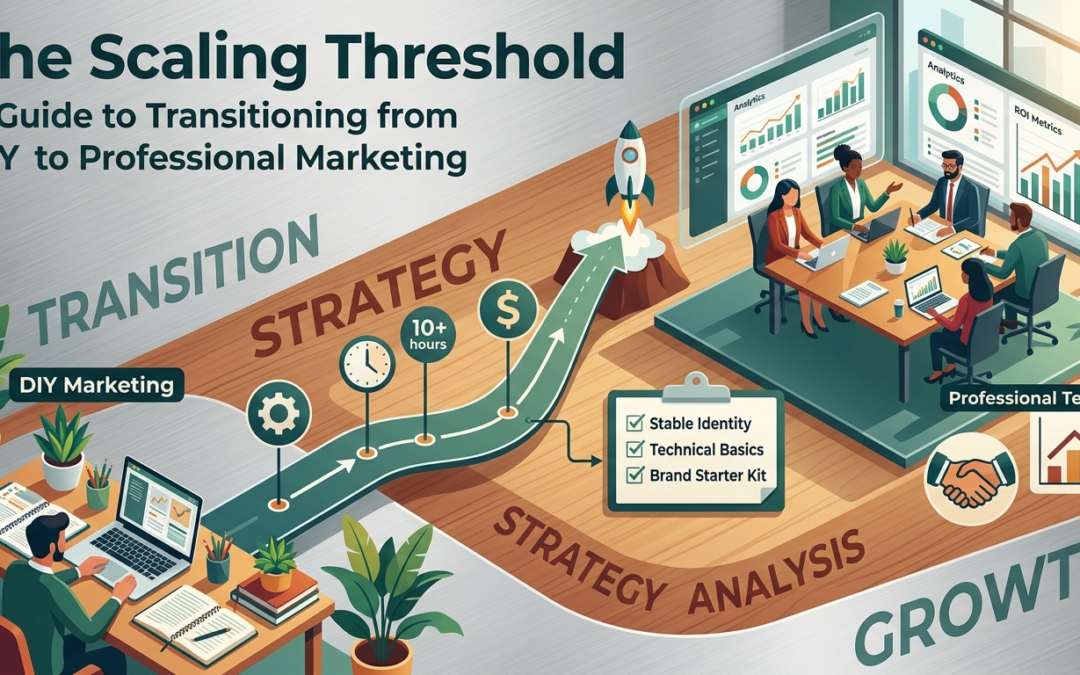
The most significant indicator for hiring help is the “opportunity cost” of your own schedule. When promotional tasks begin to consume 10 or more hours of your work week, you are likely neglecting the high-level leadership duties that only you can perform. Furthermore, if your revenue has plateaued despite your best efforts, it is often a sign that your current strategy has reached its limits and requires a specialized perspective to break through.
However, readiness is not just about being busy; it is about being financially prepared. Professional marketing should be funded by consistent revenue that does not jeopardize your daily operations. Attempting to hire an agency while cash flow is under heavy stress often creates a high-pressure environment that can lead to poor decision-making and diminished results.
Building the Infrastructure for Success
An external partner cannot successfully market an undefined destination. Before seeking help, ensure your business has several key foundations in place:
Stable Identity: You must have a clear understanding of your target customer’s buying behavior and a consistent pricing model.
Technical Basics: You must have a website with functional analytics in place so that any campaign’s success can be measured with hard data rather than guesswork.
Brand Starter Kit: To avoid wasting expensive agency hours on the basics, have a finalized logo, a defined color palette, and a clear tone of voice ready to go.
Strategic Delegation vs. In-House Control
Hiring a professional is a partnership, not a total hand-off. You should expect to dedicate at least 2 to 3 hours each week to reviewing progress and providing feedback. While you should delegate technical and time-heavy tasks, you must keep certain “soul-of-the-business” elements in-house.
Specifically, you should always retain control over your brand’s fundamental narrative, as only you truly know your story. Direct customer relationships, such as responding to comments or reviews, should remain personal. Most importantly, you must maintain final approval over every strategy and campaign before it goes live.
Conversely, technical areas such as search engine optimization (SEO), content production, and paid ad management are excellent candidates for outsourcing. These disciplines require daily optimization and specialized skills where small mistakes can be costly. Similarly, high-quality graphic design and video production directly affect brand trust and are often best handled by specialists.
Setting Realistic Expectations
Marketing is a marathon, not a sprint. To protect your business, always start with a short-term, scoped pilot project or a 90-day trial rather than a year-long commitment to ensure the cultural and professional fit is right. Agree on specific numerical KPIs, such as leads, sales, or acquisition costs, in writing before the contract begins.
It is also vital to ensure that all ad accounts, domains, and analytics profiles remain in your name, not the agency’s. Finally, budget for a “lag” period; expect at least a 4 to 8-week window for paid ads to fully optimize and 3 to 6 months for SEO efforts to show significant movement.
If you are currently managing an online storefront and want to ensure your foundations are strong enough for professional scaling, proactive preparation is essential.
Connect with us to understand the metrics and infrastructure required to transform your digital presence into a high-growth enterprise.
Follow us on LinkedIn – Build, Grow, Convert.

About Mike Doherty
Mike Doherty serves as Chief Experience Officer at Greening Projects, a nonprofit organization dedicated to transforming underutilized urban spaces into vibrant green areas that benefit communities and the environment. With a passion for urban revitalization and community-centered approaches, Mike oversees the end-to-end experience of residents, volunteers, municipal partners, and donors involved in the organization’s green space conversion projects. His role encompasses strategic vision, community engagement, and ensuring that every interaction reflects Greening Projects’ commitment to creating accessible, sustainable urban oases. Under his leadership, the experienced team focuses on making green space development collaborative, impactful, and meaningful for all stakeholders while fostering stronger, healthier neighborhoods through environmental transformation.