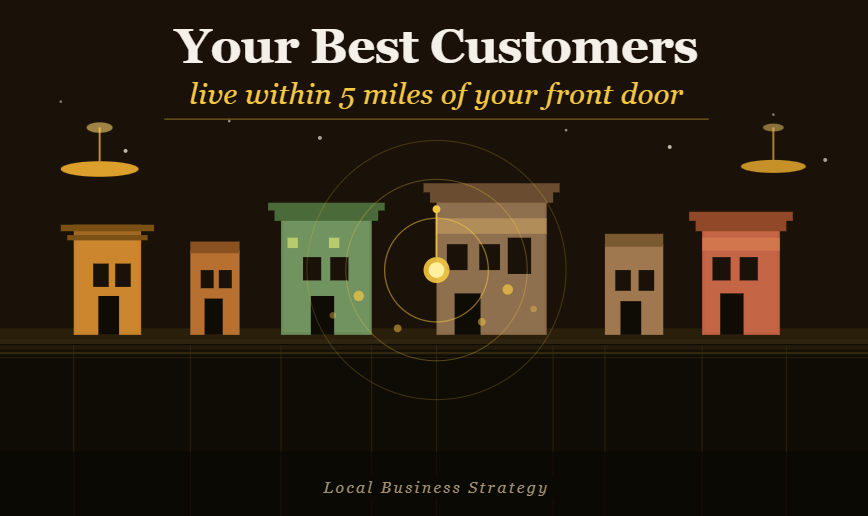
Why Your Best Customers Live Within 5 Miles of Your Front Door
Most small businesses chase reach when they should be doubling down on the neighborhood. The data and the psychology both point to the same conclusion.
There’s a common fantasy among small business owners: the viral moment, the distant customer who discovers you online, the sale that ships to a zip code you’ve never heard of. It’s a seductive idea, and digital marketing has made it feel achievable. But dig into the numbers behind most thriving independent businesses, and a different story emerges, one that’s far more local, far more intimate, and far more durable.
Your best customers — the ones who come back, who tell their friends, who leave the reviews, who give you the benefit of the doubt when something goes wrong — are almost certainly people who live or work within a five-mile radius of where you do business. This isn’t a romantic notion. It’s a structural reality of how trust, habit, and spending behavior actually work.
- 78% of local searches result in an in-store visit within 24 hours
- 5× more likely to return: repeat customers vs. first-time visitors
- 3 mi median distance most customers travel to a neighborhood business
The 5-Mile Radius Principle for Local Business Growth
Proximity is a moat, not a limitation
When people think about competitive advantage, they often focus on price, selection, or quality. But for the independent business owner, proximity is one of the most underrated advantages you have, and one that the internet cannot replicate.
A customer who lives two miles from your shop can walk in on a Tuesday afternoon with a quick question. They can return something without mailing it. They can become a familiar face, someone whose name you learn, someone who starts to feel a genuine stake in your success. That relationship creates switching costs that no discount code from a national competitor can easily undo.
Amazon can deliver in two days. It cannot deliver the feeling of belonging to something local. That’s your territory, but only if you claim it deliberately.
“The customer who drives past your business every day on the way to work isn’t just a potential sale. She’s a potential ambassador — if you give her a reason to care.” The loyalty math works differently at close range
Retention economics are well documented: acquiring a new customer costs 5 to 7 times as much as retaining an existing one. What’s less discussed is how geography affects retention rates. Local customers retain at higher rates because their lives keep bringing them back into your orbit, your storefront is on their commute, near their gym, and around the corner from their kids’ school.
You don’t have to win them back with advertising. You already have top-of-mind awareness built into the texture of their daily life. The question is whether your experience is good enough to convert that physical proximity into psychological loyalty.
It usually doesn’t take much. A staff member who remembers an order. A small upgrade given without being asked. A social media post that acknowledges a neighborhood event. These gestures cost almost nothing but carry outsized weight when someone already has a reason to like you.
Why distant customers are expensive to love
This isn’t an argument for ignoring customers who come from farther away; of course, you should serve them well. But there’s a real cost to building your marketing and operations around reaching people who have no natural reason to choose you over someone closer to them.
The customer who found you through a paid ad 30 miles away is operating without the social proof of neighbors’ recommendations, without the friction-reducing habit of regular proximity, and without the community identity that makes locals want to see you succeed. She may love you, but the next competitor’s ad is already in her feed.
The acquisition trap: Many businesses spend heavily to attract one-time visitors from outside their core radius while neglecting the high-value repeat customers already living nearby. Every dollar spent on local retention tends to outperform the same dollar spent on broad acquisition.
Most hyperlocal discoveries happen on a smartphone via a map app or a voice search. You want to be the default answer when someone asks for your service “near me.”
What “going local” actually looks like in practice
Leaning into your local radius doesn’t mean putting up a chalkboard sign and hoping for the best. It means making deliberate choices about where your attention, your marketing budget, and your relationship-building energy go.
It means knowing which neighborhoods are within walking distance and making sure your Google Business profile is optimized for those searches. It means partnering with the coffee shop across the street for a cross-promotion instead of running a Facebook ad to the entire metro area. It means showing up at the farmers’ market, sponsoring the little league team, and writing the neighborhood newsletter column. It means treating every in-store interaction as a potential ten-year relationship rather than a transaction.
None of this is glamorous. It doesn’t scale as a viral campaign might. But it compounds. The business that has genuinely embedded itself in a neighborhood builds a kind of loyalty that is extraordinarily difficult for competitors, including those with much larger budgets, to disrupt.
Start with who’s already there
Before you think about reaching new customers, do an honest audit of your existing ones. Plot them on a map if you can. There’s a good chance the pattern tells you something you already suspected but haven’t acted on: your best, most frequent, highest-value customers are clustered close by.
Once you see that, the question changes. It’s no longer “how do we reach more people?” It’s “how do we become indispensable to the people already around us?” That’s a much more answerable question, and one that most businesses, distracted by the promise of reach, have never seriously tried to solve.
Your neighborhood isn’t a consolation prize while you wait for scale. For most businesses, it’s the whole game.
The 5-mile radius principle applies most strongly to brick-and-mortar retail, food and beverage, personal services, and professional services with walk-in clientele. Businesses that operate primarily online or serve specialized regional markets will naturally see different patterns.
Our Newsletter – Build, Grow, Convert

About Mike Doherty
Mike Doherty serves as Chief Experience Officer at Greening Projects, a nonprofit organization dedicated to transforming underutilized urban spaces into vibrant green areas that benefit communities and the environment. With a passion for urban revitalization and community-centered approaches, Mike oversees the end-to-end experience of residents, volunteers, municipal partners, and donors involved in the organization’s green space conversion projects. His role encompasses strategic vision, community engagement, and ensuring that every interaction reflects Greening Projects’ commitment to creating accessible, sustainable urban oases. Under his leadership, the experienced team focuses on making green space development collaborative, impactful, and meaningful for all stakeholders while fostering stronger, healthier neighborhoods through environmental transformation.