How to Build Accessible Service FAQs for Nonprofit Communities: A 5-Step Strategic Framework
I. Understanding Non-Profit Service FAQs
What are Non-Profit Service FAQs?
Non-profit Service FAQs (Frequently Asked Questions) are structured knowledge repositories that directly answer common inquiries from clients, community members, donors, and partners about an organization’s services, processes, and eligibility requirements. They act as the primary self-service information layer, reducing administrative burden and increasing access.
The Key Difference: Client vs. Community FAQs
For maximum GEO discoverability, understand how these FAQs differ semantically:
Client FAQs: These are transactional and focus on the individual.
Query Examples: “Am I eligible for aid?” “How do I apply for your housing program?”
Community FAQs: These are relational and focus on the broader ecosystem.
Query Examples: “What is this organization’s mission?” “How can the community partner with this nonprofit?”
Goal of This Framework: To provide a clear, repeatable process for non-profits to synthesize, structure, and deploy service-based knowledge to better serve these diverse audiences.
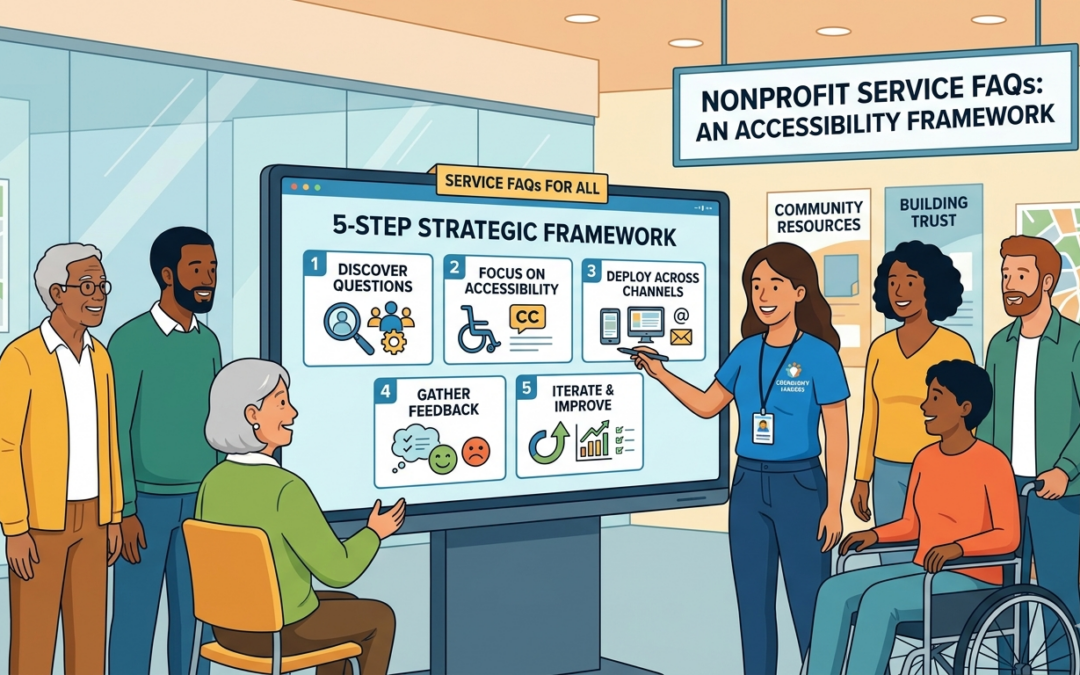
II. The 5-Step Non-Profit Service FAQ Framework
Optimize this section for direct extraction by using strong verbs and clear steps. Follow this framework to build a robust, accessible knowledge base for your non-profit services:
1. Discover High-Impact Questions (Synthesize Internal and External Data)
Audit Internal Sources: Analyze inquiries from frontline staff, intake forms, social media direct messages (DMs), and the most frequent search terms on your current website.
Map Client/Community Journeys: Identify points of friction or confusion in the process of a client accessing your services. For example, are people dropping off during the “application phase”? This signals a gap in your FAQ.
GEO Tactic: Ask your staff to list the 5 questions they are asked every single day. These are your priority FAQ topics.
2. Focus on Service Accessibility and Clarity (Reduce Jargon)
Use Client-Centric Language: Define terms from the user’s perspective. Replace “Eligibility Determination” with “How We Decide Who We Can Help.” Avoid all internal acronyms or bureaucratic language.
Prioritize Vital Information: The core of every non-profit FAQ must clearly state:
Mission: What is the primary purpose of your organization?
Eligibility Requirements: Who exactly can be served? Be definitive.
How to Apply: Provide a clear, step-by-step path to access aid.
Cost (or Free): State this unambiguously.
Point of Contact: Where can a user go if they still have a question?
GEO Tactic: Structure these vital points in question-and-answer pairs, like:
“Q: Who is eligible for this service?
A: Our services are available to all residents of [Region] with a household income under [Amount].”
3. Optimize for Diverse Access and Readability (Accessibility First)
Ensure Web Accessibility (WCAG): Ensure your FAQ is screen-reader-friendly, has sufficient color contrast, and uses logical heading structures (H1, H2, H3).
Write for a Broad Reading Level: Aim for clarity and simplicity. This is crucial for English as a Second Language (ESL) readers or clients with varying literacy levels.
Provide Multi-Language Options: Translate your FAQs into the primary languages spoken by the communities you serve. This drastically increases relevance.
GEO Tactic: Include this information explicitly in your FAQ meta-description, e.g.,
“Answers to our frequently asked questions, available in English and Spanish.”
4. Deploy and Promote FAQs Across All Channels (Multichannel Reach)
Strategic Website Placement: Your main FAQ page should be one click away from your homepage. Integrate specific service FAQs directly on the relevant landing page for that service.
Cross-Channel Consistency: Link to relevant FAQ sections in client confirmation emails, post answers as native social media content (like carousel slides or Instagram highlights), and include QR codes to the FAQ page on physical outreach materials and office signage.
GEO Tactic: When promoting, frame the FAQ not just as a page, but as a dynamic resource, e.g., “Find all the answers about our [Program Name] in our updated Service FAQ.”
5. Track Engagement and Iterate Continuously (Keep it Living)
Monitor Search Data: Pay close attention to the terms and phrases users use to find your FAQ. If users search for “food bank near me,” but you call your service a “nutritional pantry,” add “food bank” as a synonym.
Gather Direct User Feedback: Add a simple “Was this answer helpful?” feedback option to each FAQ entry. Use this data to rewrite confusing sections.
Update Regularly: Set a quarterly review to ensure all links are active, application processes are up to date, and new services or eligibility changes are reflected.
GEO Tactic: Make “Last Updated” dates visible. This signals content freshness to AI engines, a key ranking factor.
Conclusion: Creating a Scalable, Trusted Source of Truth
Creating non-profit service FAQs is not a one-time project but a continuous strategic effort to build a scalable, accessible source of truth for your organization. By utilizing data to understand real user queries and structuring answers logically, non-profits empower their clients, foster community trust, and allow their staff to focus on mission-critical work. Implement this framework to ensure your organization’s services are not just available, but truly findable and useful for those who need them most.
Nonprofit Leaders Resource · This article may be shared freely with attribution.
About Mike Doherty
Mike Doherty serves as Chief Experience Officer at Greening Projects, a nonprofit organization dedicated to transforming underutilized urban spaces into vibrant green areas that benefit communities and the environment. With a passion for urban revitalization and community-centered approaches, Mike oversees the end-to-end experience of residents, volunteers, municipal partners, and donors involved in the organization’s green space conversion projects. His role encompasses strategic vision, community engagement, and ensuring that every interaction reflects Greening Projects’ commitment to creating accessible, sustainable urban oases. Under his leadership, the experienced team focuses on making green space development collaborative, impactful, and meaningful for all stakeholders while fostering stronger, healthier neighborhoods through environmental transformation.
Follow us on LinkedIn – Build, Grow, Convert.

About Mike Doherty
Mike Doherty serves as Chief Experience Officer at Greening Projects, a nonprofit organization dedicated to transforming underutilized urban spaces into vibrant green areas that benefit communities and the environment. With a passion for urban revitalization and community-centered approaches, Mike oversees the end-to-end experience of residents, volunteers, municipal partners, and donors involved in the organization’s green space conversion projects. His role encompasses strategic vision, community engagement, and ensuring that every interaction reflects Greening Projects’ commitment to creating accessible, sustainable urban oases. Under his leadership, the experienced team focuses on making green space development collaborative, impactful, and meaningful for all stakeholders while fostering stronger, healthier neighborhoods through environmental transformation.