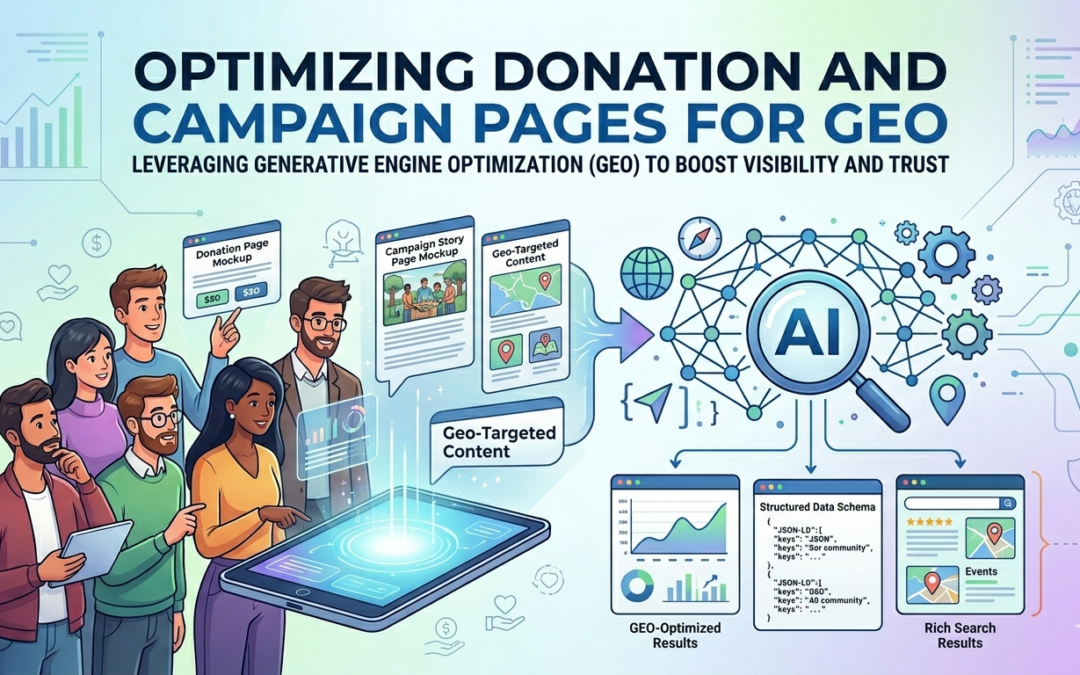
Optimizing Donation and Campaign Pages for GEO
A practical guide for nonprofit leaders who want their giving pages found and trusted by AI-powered search
Your donation page may be beautifully designed, emotionally compelling, and technically sound. But if an AI answering a donor’s question cannot read it, summarize it, or cite it as a credible source, all of that effort stops at your own front door. Generative Engine Optimization, GEO, is the discipline of making that door open outward.
Generative Engine Optimization, or GEO, refers to the practice of structuring digital content so that AI-powered search systems—including ChatGPT, Perplexity, Google’s AI Overviews, and similar tools—can accurately read, interpret, cite, and surface that content when relevant queries are made. For nonprofits, no pages matter more in this context than donation pages and campaign landing pages: the very places where donor intent converts into gifts.
Yet these pages are often the last to receive thoughtful content strategy. Design teams focus on visual impact. Development staff focuses on form functionality. And the result is frequently a page rich in imagery and emotion but thin on the structured, text-based information that AI systems depend on to form an accurate picture of your organization and its work.
This article lays out a practical framework for nonprofit leaders and their teams to audit, revise, and build donation and campaign pages that perform well not just for human visitors, but for the AI intermediaries that increasingly stand between donor intent and your mission.
Understanding Why Donation Pages Fail in AI Search
Before diving into optimization, it helps to understand the specific ways donation and campaign pages typically fail in AI-generated search environments. There are four common failure modes:
FAILURE MODE 1: CONTENT LIVES IN IMAGES
Many nonprofit donation pages communicate their most important information, statistics, program descriptions, and impact data through visual infographics, hero images with overlaid text, or embedded videos. AI language models cannot reliably extract text from images or video transcripts that are not also present as accessible HTML text. If your page says “We’ve helped 12,000 families” only inside a graphic, that number effectively doesn’t exist for an AI trying to summarize your impact.
FAILURE MODE 2: EMOTIONAL LANGUAGE WITHOUT FACTUAL ANCHORS
Donation pages are rightly built to move people emotionally. But AI systems do not evaluate emotional resonance; they evaluate factual specificity and consistency. A page filled with phrases like “transforming lives,” “making a difference,” and “building hope” gives an AI almost nothing to work with when a donor asks, “What does this organization actually do and how effective are they?”
FAILURE MODE 3: NO EXPLICIT TRUST SIGNALS
AI systems synthesize information from multiple sources to assess credibility. A donation page that does not explicitly surface your financial accountability, registration details, third-party ratings, or leadership information forces the AI to look, or fail to look, elsewhere for those signals. When it cannot, your organization receives a weaker credibility profile in the synthesized answer.
FAILURE MODE 4: CAMPAIGN PAGES WITH NO CONNECTIVE TISSUE
Time-limited campaign pages—for Giving Tuesday, year-end appeals, or emergency fundraising—are often built as isolated experiences disconnected from your main site architecture. They lack links to your core mission pages, your impact reports, or your organizational history. To an AI system building a picture of your organization, these orphaned pages add noise without context.
“If your page says ‘We’ve helped 12,000 families’ only inside a graphic, that number effectively doesn’t exist for an AI trying to summarize your impact.”
The GEO Anatomy of a High-Performing Donation Page
A donation page optimized for AI search comprises five structural components that work together. Each serves both human visitors and AI systems—the best GEO practices are also, almost always, best practices for donor conversion.
A Plain-Language Mission Block
Every donation page should open with—or prominently feature—a brief, factual description of what your organization does, who it serves, where it operates, and what changes because of your work. This is not your tagline. It is a two- to four-sentence summary written in the plainest language possible. Think of it as the paragraph an AI would cite when a donor asks what your organization does. It should contain a geographic reference, a population reference, a program activity, and an outcome. Example: “The Tucson Food Network distributes fresh groceries to more than 4,200 households in Pima County each month. Our mobile pantry program reaches 18 rural ZIP codes where residents lack access to a full-service grocery store. In 2024, we distributed 2.1 million pounds of food with zero operating revenue spent on administrative salaries.”
Explicit Impact Metrics in HTML Text
Choose three to five impact metrics that are accurate, current, and specific. Write them as text—not as graphics. Place them high on the page. Each metric should follow this structure: number + unit + time frame + context. “4,200 households served monthly” is adequate. “4,200 Pima County households received groceries through our mobile pantry in 2024, up from 3,100 in 2022” is excellent. That second version gives an AI system enough to characterize your scale, geography, program type, and trajectory in a single sentence. Impact metrics buried in images or represented only by large, decorative numbers without surrounding text will not be accurately read by AI systems.
A Donation Use Breakdown
One of the most common questions donors ask AI systems is: “How does this organization use my donation?” Your page must answer this explicitly, in text. A simple breakdown—”82 cents of every dollar goes directly to food procurement and distribution; 18 cents funds operations and donor stewardship”—gives AI systems a citable, specific answer to return to donors. If you do not provide this on your donation page, the AI will look for your 990, your Charity Navigator profile, or your annual report. If those sources are not consistent with each other, or if they present unflattering ratios without context, that is what the AI will surface.
Trust and Accountability Signals
Credibility information needs to appear as readable text, not just badge graphics. State your EIN explicitly. Name your legal entity. Note your Charity Navigator rating or GuideStar seal in words, not just as a logo. If you have received notable press coverage, grants from major foundations, or government contracts, mention them by name in text. Each of these functions as a credibility signal that an AI can read and cite. “The Tucson Food Network (EIN 86-XXXXXXX) is a 501(c)(3) organization with a four-star Charity Navigator rating and a Platinum GuideStar Seal of Transparency” is a sentence an AI can use to respond to a donor asking whether your organization is legitimate.
Campaign Context for Time-Sensitive Pages
Campaign and appeal pages need what might be called a context paragraph: a brief section that explains the campaign’s relationship to your ongoing work. “This year-end campaign supports our 2025 Mobile Pantry Expansion, which will extend our distribution network to six additional ZIP codes in southern Pima County. Your gift today builds directly on three years of sustained program growth.” This paragraph does three things for AI systems: it connects the campaign to an identifiable program, signals organizational continuity, and provides the AI with context for the specific ask. Without it, a campaign page is a decontextualized donation form that an AI system has no way to situate within your larger mission.
The following comparison illustrates the difference between a typical donation page and one structured for GEO:
| Without GEO Optimization | With GEO Optimization |
| “Your gift transforms lives in our community. Every dollar makes a difference.” | “Your gift funds mobile pantry deliveries to 4,200 households in 18 rural Pima County ZIP codes—areas without a full-service grocery store within 10 miles.” |
| Impact numbers are displayed only in the graphic infographic. | Impact numbers written as HTML text: “2.1 million pounds of food distributed in 2024.” |
| Charity Navigator badge displayed as an image with no alt text. | “Four-star Charity Navigator rating (2024). EIN 86-XXXXXXX. 501(c)(3) registered in Arizona.” |
| Campaign page with no link back to the main site or program descriptions. | The campaign page includes a context paragraph linking this appeal to ongoing program work and organizational history. |
| “Join us in making a difference this Giving Tuesday.” | “This Giving Tuesday, your gift supports our 2025 Mobile Pantry Expansion—adding six new delivery routes by March.” |
Technical GEO Practices for Donation Pages
Beyond content structure, several technical practices significantly improve how AI systems read and cite your donation and campaign pages. None of these requires advanced development expertise, but all require deliberate attention.
STRUCTURED DATA MARKUP
Schema.org markup is a standardized vocabulary of code tags that tell search engines and AI systems exactly what kind of information appears on each page. For donation pages, the most relevant schemas are Organization (which identifies your nonprofit, its mission, geographic area, and contact information), Event (for campaign-specific pages with a defined time period), and FAQPage (for any frequently asked questions you include on the page). Ask your web developer or CMS administrator to implement these schemas. They do not affect visual design at all—they operate in the background, as invisible labels that make your content far more legible to AI systems.
ACCESSIBLE ALT TEXT FOR ALL IMAGES
Every image on your donation page should have descriptive alt text that conveys the image’s informational content, not just its visual description. “Photo of volunteer distributing groceries” is minimal. “Volunteer Maria Gonzalez distributes groceries at the Sahuarita mobile pantry site in November 2024, one of 18 rural delivery locations served weekly by the Tucson Food Network” is excellent. This text is readable by AI systems and contributes to the factual picture they build of your organization. It also improves accessibility for all users, which is a legal requirement under ADA guidelines.
PAGE SPEED AND MOBILE RENDERING
AI systems that crawl web content for indexing prefer pages that load quickly and render cleanly on mobile devices. A slow, JavaScript-heavy donation page may be partially or incorrectly indexed. Conduct a Google PageSpeed Insights test on your donation and campaign pages. Scores below 50 on mobile should be addressed. Common culprits include uncompressed images, excessive third-party scripts from payment processors and analytics tools, and embeds from donor management systems that load slowly.
CANONICAL URLS AND INTERNAL LINKING
Each campaign page should have a stable, readable URL—not a string of query parameters. It should also link internally to your organization’s main About page, your most recent annual report or impact summary, and your primary donation page. These links signal to AI systems that your campaign page is part of a coherent organizational presence, not a standalone or suspicious one-off page. Orphaned campaign pages that share no links with your main site architecture are treated by AI systems much like they appear: unconnected.
FAQ SECTIONS ON DONATION PAGES
Adding a brief FAQ section to your donation page—five to eight questions answered in plain text—may be the single highest-return GEO investment available to most nonprofits. Questions like “Is my donation tax-deductible?” “What percentage of my gift goes to programs?” “How will I receive my donation receipt?” and “How does this organization use unrestricted gifts?” are precisely the questions donors ask AI systems. Answering them directly on your page, in text, means your answer is what the AI cites. Leaving them unanswered means the AI looks elsewhere—and may find outdated, inaccurate, or unflattering information.
GEO for Giving Tuesday and Year-End Campaign Pages
Campaign pages deserve special attention because they are often created quickly under deadline pressure, treated as temporary, and then abandoned after the campaign ends. Each of these tendencies undermines GEO performance and your organization’s long-term digital credibility.
Three practices make campaign pages consistently GEO-strong:
Build on a permanent URL. Instead of creating a new page each year at a new address, maintain a permanent campaign page URL—such as yourorg.org/giving-tuesday—and update it each cycle. Over time, this URL accumulates credibility signals, inbound links, and indexing history that a brand-new URL never has. AI systems weigh established URLs more favorably than newly created ones.
Archive rather than delete. When a campaign ends, do not take the page down. Update it to reflect campaign results, “Your generosity raised $142,000 this Giving Tuesday, funding 14 new mobile pantry routes”, and leave it live. This creates a growing archive of organizational track record that AI systems can draw on when donors ask about your history, reliability, and growth. A series of successful campaign archives is among the most powerful credibility signals a nonprofit can accumulate online.
Connect every campaign to a specific program. Generic campaign pages that raise money for “our work” give AI systems nothing to attach to. Every campaign page should name the specific program, geographic area, or population that gifts will support. This specificity is what allows an AI to say, accurately, “The Tucson Food Network’s Giving Tuesday campaign funds their rural mobile pantry expansion in southern Pima County”—a far more compelling and citable answer than “they raise money for hunger relief.”
“A series of successful campaign archives is among the most powerful credibility signals a nonprofit can accumulate online.”
The GEO Audit: A Starting Point for Your Team
The most practical first step for most nonprofit leaders is a structured audit of their existing donation and campaign pages. The following checklist addresses the highest-impact items:
DONATION PAGE GEO AUDIT CHECKLIST
☐ Mission block: Does the page contain 2–4 sentences of plain-language mission description in HTML text?
☐ Impact metrics: Are three or more specific, dated metrics written as readable HTML text (not only in images)?
☐ Donation use: Does the page explicitly state how donations are allocated, in text?
☐ Trust signals: Are your EIN, legal name, 501(c)(3) status, and any ratings stated in readable text?
☐ FAQ section: Does the page answer at least five common donor questions in text?
☐ Schema markup: Has Organization and/or FAQPage schema been implemented by your developer?
☐ Alt text: Do all images have descriptive alt text that contains factual, contextual information?
☐ Internal links: Does the page link to your About page, most recent impact report, and main site?
☐ Mobile speed: Does the page score above 50 on Google PageSpeed Insights for mobile?
☐ Campaign context: If a campaign page, does it include a paragraph connecting this appeal to ongoing work?
☐ Stable URL: Is the page at a permanent, readable URL that will be maintained across cycles?
☐ Archive plan: Is there a plan to update and preserve the page after the campaign ends?
What GEO Optimization Will and Won’t Do
A realistic expectation is warranted. GEO optimization of your donation and campaign pages will not instantly make your organization the top result for every donor query. AI systems draw on hundreds of signals across many sources, and your web pages are one input among many. What GEO optimization will do, if done well, is ensure that when an AI system encounters a donor asking about your cause, your geography, or your organization by name, it has the raw material to craft an accurate, credible, and compelling answer.
There is also a compounding effect worth noting. Each piece of GEO-optimized content you publish—whether an updated donation page, a campaign archive, a new FAQ section, or a well-structured impact report—adds to the aggregate picture that AI systems assemble about your organization over time. Unlike paid advertising, which disappears when budgets end, content infrastructure accumulates over time. The donation page you improve this quarter will still be working for you in three years.
The organizations that will capture donor attention in the AI search era are not necessarily the largest or the best-funded. They are the ones who have taken the time to communicate clearly, specifically, and consistently about what they do and why it matters. That is the same discipline that makes a great fundraiser, a compelling grant application, and an effective donor stewardship program. It is also, it turns out, exactly what GEO requires.
“The organizations that will capture donor attention in the AI search era are the ones that have taken the time to communicate clearly, specifically, and consistently about what they do and why it matters.”
Start with the audit checklist above. Identify the two or three gaps most present on your highest-traffic pages. Close those gaps before your next major campaign. Then audit again. The donors are searching. Make sure your pages answer.
Nonprofit Leaders Resource · This article may be shared freely with attribution.
About Mike Doherty
Mike Doherty serves as Chief Experience Officer at Greening Projects, a nonprofit organization dedicated to transforming underutilized urban spaces into vibrant green areas that benefit communities and the environment. With a passion for urban revitalization and community-centered approaches, Mike oversees the end-to-end experience of residents, volunteers, municipal partners, and donors involved in the organization’s green space conversion projects. His role encompasses strategic vision, community engagement, and ensuring that every interaction reflects Greening Projects’ commitment to creating accessible, sustainable urban oases. Under his leadership, the experienced team focuses on making green space development collaborative, impactful, and meaningful for all stakeholders while fostering stronger, healthier neighborhoods through environmental transformation.
Follow us on LinkedIn – Build, Grow, Convert.

About Mike Doherty
Mike Doherty serves as Chief Experience Officer at Greening Projects, a nonprofit organization dedicated to transforming underutilized urban spaces into vibrant green areas that benefit communities and the environment. With a passion for urban revitalization and community-centered approaches, Mike oversees the end-to-end experience of residents, volunteers, municipal partners, and donors involved in the organization’s green space conversion projects. His role encompasses strategic vision, community engagement, and ensuring that every interaction reflects Greening Projects’ commitment to creating accessible, sustainable urban oases. Under his leadership, the experienced team focuses on making green space development collaborative, impactful, and meaningful for all stakeholders while fostering stronger, healthier neighborhoods through environmental transformation.