Nonprofit Fundraising Fundamentals: Revenue Streams Explained
An overview of the core non-profit revenue models, helping you determine the right mix of individual giving, grants, events, and earned income.
Nonprofit Fundraising Fundamentals: Revenue Streams Explained
Strategy & Governance | Fundraising & Development | Marketing & Brand | Programs & Impact
Operations & Finance | Technology & Infrastructure | Advocacy & Equity | Frequently Asked Questions
Where the Money Actually Comes From
Maria had been executive director of the neighborhood greening nonprofit for three years before she finally admitted to her board that she had no idea, really, where next year’s money was coming from. Not exactly. She knew the broad strokes, a grant here, a gala there, some steady monthly donors, but she’d never sat down and mapped it out. When she finally did, over a long weekend with a spreadsheet and too much coffee, she learned something that most seasoned fundraisers eventually figure out on their own. No single source of money keeps an organization alive. It’s the mix that matters.
That holds true across the nonprofit world. Organizations that weather bad years, leadership transitions, and shifting donor moods tend to be the ones that never let themselves depend too heavily on any one revenue stream. They pull from several directions at once: individuals, grants, events, sales of goods or services, corporate partners, memberships. The specific blend depends entirely on who they are. A food bank’s revenue mix looks nothing like a chamber orchestra’s, and neither should try to copy the other’s playbook. What works depends on the mission, on who the audience is, on how many staff members are available to chase down funding, and on how much risk the board can stomach.
What a Revenue Stream Actually Is
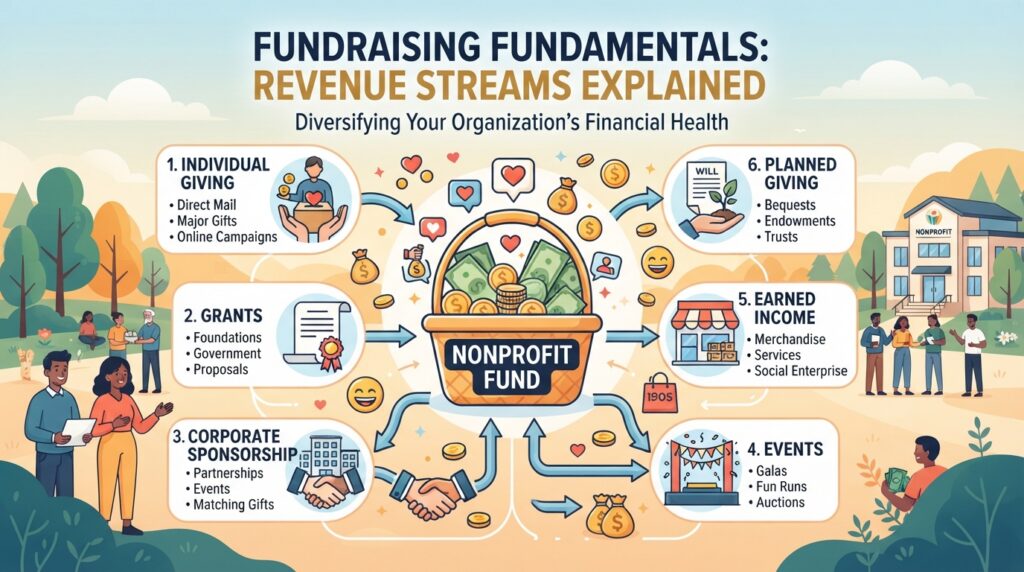
Before Maria could build a plan, she had to be precise about vocabulary, a step many organizations skip. A revenue stream is simply a distinct channel through which money flows into the organization. Individual gifts are one. Foundation and government grants are another. Then there are government contracts, ticketed events, membership dues, program fees, corporate sponsorships, bequests in wills, investment income, and donated goods or services. Candid, the research organization that tracks nonprofit finances, narrows most of this down to four broad buckets: individual donors, grants, earned income, and government funding. Nearly every organization draws from more than one.
Here’s the distinction that tripped Maria up at first. A revenue source and a fundraising tactic are not the same thing. An online giving campaign, a black-tie gala, and a friend-to-friend peer fundraising push can all funnel money from the same underlying source, individual generosity, even though they look completely different on the outside. Knowing which lever you’re actually pulling matters when you’re trying to figure out why revenue is up or down.
The People Who Give Because They Believe
Individual giving was the stream Maria understood best, mostly because it was the most personal. People wrote checks, set up recurring monthly gifts, occasionally left something extraordinary in an estate plan, or rallied their friends around an online birthday fundraiser. This category covers a lot of ground: annual appeals sent out a few times a year, monthly giving programs that provide dependable income, major gifts cultivated over time through genuine relationships, peer-to-peer campaigns where supporters fundraise on your behalf, crowdfunding tied to a specific need, and memorial gifts made in someone’s honor.
The money is only part of why individual donors matter. A first-time $25 donor might, a few years later, be sitting on the board, or volunteering every Saturday, or telling their neighbors why this organization matters. That’s the upside. The downside is real too. Small-dollar donor programs eat up staff time disproportionate to what they raise, revenue can swing with the broader economy, and building the kind of trust that leads to a major gift or planned gift takes years, not weeks. An organization serious about this stream usually needs more than a once-a-year appeal letter. It needs a whole journey, from welcoming new donors to keeping them updated on impact to eventually inviting the right people into deeper conversations about legacy giving.
Grants Are Powerful, but Never Guaranteed
Grants were the funding stream for the garden’s construction: money awarded by foundations, corporations, government agencies, or community funds, usually earmarked for a specific program or project, or sometimes for general operating support. Grants can be sizable. They can also come with strings attached, making them harder to use than their dollar value suggests.
The category splits into several flavors. Private and family foundation grants. Corporate grants. Government grants. Government contracts that pay for the delivery of a defined service. Capacity-building grants are aimed at things like new software or staff training. Capital grants for buildings and equipment. Challenge grants release funds only after the nonprofit matches them with funds raised from other sources.
The appeal is obvious. Grants can fund work that individual donors never would, and landing one from a respected funder often opens doors with other funders. But the cost of that appeal is real too. Applications can take weeks to prepare. Money often comes with tight restrictions on how it’s spent. Reporting requirements can be demanding enough to require dedicated staff time. Grants frequently don’t cover the full cost of running a program: administrative overhead, evaluation, fundraising itself. Renewal is never promised.
Maria learned to ask a harder question before applying for anything. Does this grant actually help, or does it just fund the fun part of a program while leaving her organization to cover the boring, expensive parts out of pocket? A grant that pays for the celebrated summer camp but excludes rent, insurance, and staff salaries isn’t solving a financial problem so much as relocating it.
Events Bring More Visibility Than Revenue, Usually
Every fall, Maria’s organization threw a community planting day with a small fundraising ask built in. It felt successful until she actually calculated net revenue. Events, whether they’re galas, 5Ks, auctions, or backyard house parties, are less a distinct source of revenue and more a method for raising funds from other sources. Ticket sales are earned income. Sponsorship dollars are corporate support. The auction paddle-raise at the end of the night is individual giving, dressed up in black tie.
Events are genuinely useful for visibility, for attracting new people, and for creating shared stories that appear later in newsletters and social posts. But they’re also expensive to run, hungry for staff and volunteer time, and prone to looking impressive on the surface while barely breaking even underneath. The only honest way to evaluate an event is to subtract direct costs from total revenue to get net, then go further by tracking whether the people who showed up ever come back or give again. A modest gathering that deepens relationships can be worth more than a flashy one that generates a single night’s excitement and nothing else.
Earning It Through Goods and Services
Not all nonprofit revenue comes from asking. Some of it comes from selling: tuition for a class, tickets to a performance, consulting fees, merchandise, facility rentals, or running a full-blown social enterprise like a thrift store or café. Candid’s analysis of 2022 sector-wide data found that earned income made up 71 percent of aggregate revenue across U.S. nonprofits. That’s a sector-wide figure, not a target any individual organization should feel obligated to hit.
The appeal of earned income is that it can generate revenue directly tied to what the organization is already doing and reduce dependence on the unpredictability of charitable giving. But it demands things that charitable fundraising doesn’t: pricing strategy, marketing, customer service. Revenue generated from activities unrelated to the organization’s exempt purpose can even become taxable. Charging for programs can raise uncomfortable equity questions about who gets left out. A poorly conceived social enterprise can quietly become a distraction from the mission it was supposed to support, busy, but not actually profitable once every cost is counted.
When Companies Show Up
Corporate support took different forms for Maria’s organization over the years: a hardware store donating tools, a tech company matching employee donations, a local bank sponsoring the planting day banner. This bucket includes sponsorships, matching gift programs, corporate foundation grants, in-kind donations, cause-marketing tie-ins, and employee volunteer days.
Companies typically want something in return, even if it’s just goodwill: logo placement, a mention at an event, a chance for their employees to feel good about a day spent volunteering. Done well, corporate partnerships bring real resources and open doors to new audiences. Done carelessly, they can create mismatches between a company’s values and the nonprofit’s mission, or quietly shift priorities to align with the corporate partner’s marketing calendar rather than the nonprofit’s actual needs. The safeguard is unglamorous but essential: put the deliverables, timeline, recognition, and renewal terms in writing before the check arrives.
Belonging as a Business Model
Some organizations, museums, gardens, professional associations, and tight-knit community groups do especially well with membership programs, where supporters pay recurring dues in exchange for a mix of access, discounts, content, or simply the feeling of belonging. The real test of a membership program isn’t the headcount. It’s about whether the benefits genuinely deepen people’s connection to the mission without requiring an expensive administrative apparatus to sustain them. Net revenue, retention, and actual engagement matter more than the number of names on the roster.
Building the Mix That Fits
By the time Maria finished her spreadsheet exercise, she’d landed on a framework rather than a formula. There’s no universal ratio of grants to individual gifts to earned income that every nonprofit should aim for. What fits depends on the mission, on whether programs are free or fee-based, on the size and loyalty of the existing donor base, on what funding actually exists locally, on staff capacity, on how much of the budget needs to be flexible versus restricted, and on the board’s appetite for risk.
She started asking five questions about every revenue stream. Does it align with the mission? Is it flexible or restricted? Is it reliable year over year? What does it actually cost to raise? Does the organization have the capacity to pursue it well? A grant that looked generous on paper sometimes failed the last question: brilliant idea, no one to execute it.
Her own organization ended up drawing from six directions at once. Monthly gifts from neighbors who walked past the garden every day. Foundation grants that funded new construction and environmental education. A city contract that paid for ongoing maintenance. Paid workshops for schools and local businesses. An annual volunteer event that doubled as community glue. A handful of corporate sponsors supplied tools and materials. None of these streams did the same job. The grants funded growth. The individual donors provided flexibility. The city contract paid for the unglamorous, essential work of upkeep. The workshops brought in earned income while extending the mission itself.
The Real Goal Is Less Risk, Not More Sources
It would be easy to conclude that diversification means chasing every possible funding source at once. That’s not quite right, and it’s not what Maria did either. The point of a balanced revenue model isn’t maximum variety for its own sake. It’s reducing the organization’s exposure to any single funder, grant cycle, event, or economic downturn.
The useful exercise is looking backward first: pulling three to five years of financial history and, for each revenue source, examining total and net revenue, how much of it came with restrictions, how much staff time it consumed, how payments were timed, whether donors or funders renewed, and how volatile the whole thing was. That backward look usually reveals gaps. Maybe there’s strong grant funding, but almost no unrestricted money to cover the electric bill. Maybe there’s a loyal donor base that nobody has ever asked about planned giving. Maybe there’s a fee-based program that’s never actually been priced to cover its operating costs.
A resilient plan usually ends up with a few layers stacked together: a dependable base of recurring gifts, memberships, or contracts; growth capital from grants or major donors for new ideas; flexible unrestricted support to keep the lights on; mission-aligned earned income; and longer-horizon resources like bequests or reserves for the future. None of that requires an organization to chase every funding opportunity that crosses its desk. It requires a clear understanding of what each stream is actually good for and building a mix that lets the staff spend most of their energy doing the work rather than constantly scrambling to fund it.
What This Overview Doesn’t Cover
Worth saying plainly: this piece is meant to build shared vocabulary and a way of thinking about revenue, not to replace financial planning. It won’t tell you how to actually launch a monthly giving program, write a competitive grant proposal, or price an earned-income service. It doesn’t provide benchmarks for what a healthy revenue split looks like for an organization of a given size or in a given sector. That’s partly intentional, since the right mix depends too much on local context for a generic number to mean much, but it does mean you’re on your own for calibration. And it says little about the practical constraints most small and midsize nonprofits actually operate under, like a development team of one, a board with limited fundraising experience, or simply not enough hours in the week to build all six streams at once. Treat this as a starting map for orientation and conversation, then follow it with the harder, more specific work of building and sequencing a plan for your own organization.