Nonprofit Brand Guide: Story, Voice, and Visual Identity
Say who you are once, then say it the same way everywhere.
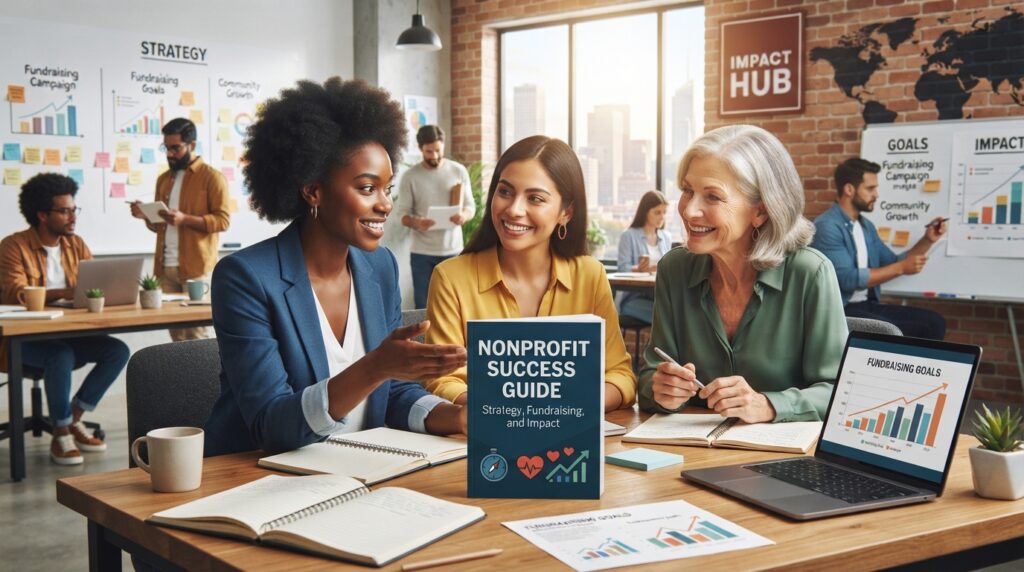
A practical guide to your nonprofit’s story, voice, and visual identity.
Jump to Resource Categories
Strategy & Governance | Fundraising & Development | Marketing & Brand | Programs & Impact
Operations & Finance | Technology & Infrastructure | Advocacy & Equity | Frequently Asked Questions
People should be able to tell what you stand for, why the work matters, why they can trust you, and how to help. A brand is the set of habits that makes that possible, whether the person is on your staff, on your board, a volunteer, a designer, or a partner. This guide builds those habits one piece at a time, so you end up with a brand guide people open when a deadline is close.
Start with your brand core
Settle the ideas underneath before you choose colors, rewrite the website, or build social templates. Answer these in plain language.
| Element | Question to answer | What you end up with |
|---|---|---|
| Purpose | Why do we exist beyond running programs? | One sentence |
| Mission | What do we do, for whom, and how? | A clear mission statement |
| Vision | What future are we helping create? | A statement of that future |
| Values | How do we act and make decisions? | Three to five values you can see in behavior |
| Audience | Whose attention, trust, money, time, or partnership do we need? | A priority list |
| Difference | Why would someone choose, fund, or partner with us over another option? | A value proposition |
| Proof | What shows we can deliver? | Evidence and credibility points |
Write a value proposition
Your value proposition answers one question: why should this audience care about us, back us, or work with us? Here is a formula. Type into the highlighted blanks, or load the example to see how it reads.
Your value proposition
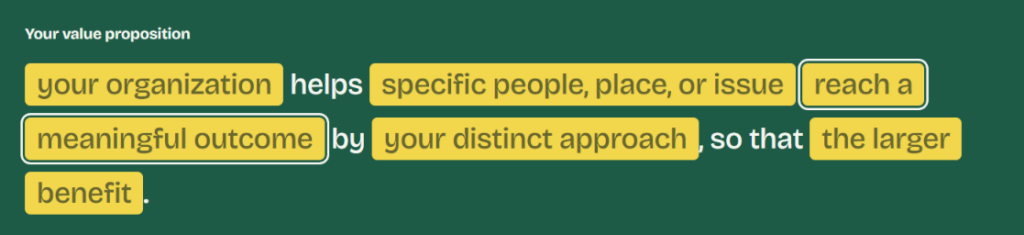
Example: Greening Projects
Greening Projects helps neighbors turn abandoned space into community gardens and parks by guiding each project from a feasibility check through community input, design, and funding, so that neighborhoods have livable places for kids to play and neighbors to enjoy the outdoors, with cleaner air, cooler streets, and less stormwater runoff.
A good value proposition:
- Names the people, communities, or places involved, in specific terms.
- Talks about outcomes, and leaves your internal activities out.
- Can be backed with evidence.
- Couldn’t be swapped for a generic line like “making a difference.”
- Bends enough to guide fundraising, partnerships, volunteer recruitment, and public communications.
Pick your priority audiences
Don’t write for everyone. Different people care about different benefits, need different proof, and get asked to do different things. Common audiences include residents, participants, and clients; donors and prospects; institutional funders; corporate and small-business partners; volunteers; government agencies and elected officials; peer nonprofits and coalition partners; media and local influencers; and your own board and staff.
For each priority audience, write down what they care about, what they need to believe, the best proof you have, and the one action you want. Four examples:
| Audience | Cares about | Needs to believe | Best proof | Main action |
|---|---|---|---|---|
| Residents | Respect, relevance, safety, access, results | “This is for and with people like me.” | Resident stories, local presence, visible projects | Participate, share input, volunteer |
| Donors | Impact, stewardship, confidence, leverage | “My gift will create real, measurable change.” | Outcomes, testimonials, transparent use of funds | Donate, renew, introduce others |
| Funders | Strategy, capacity, equity, measurable results | “This organization can execute and learn.” | Data, budget discipline, partnerships, evaluation | Fund, renew, refer |
| Partners | Alignment, reliability, mutual benefit | “Working together advances our goals.” | Track record, clear roles, co-branded outcomes | Collaborate, sponsor, refer |
Build your organizational story
Skip the organizational history. Your story should explain a problem, the people closest to it, the role you play, and the change that becomes possible. The strongest nonprofit stories pair emotion with evidence: real people and places, plus a plain account of where resources go.
Put the community at the center
Community members, participants, volunteers, and partners are usually the protagonists. You are the capable partner helping create the conditions for progress. Work through these six questions in order.
- The reality. What challenge, inequity, or missed opportunity exists?
- The stakes. Why does it matter now, and who is most affected?
- The community’s strengths. What assets, knowledge, leadership, and aspirations are already there?
- Your role. What do you add that helps move from problem to possibility?
- The change. What happens when people get the resources, relationships, tools, or spaces they need?
- The invitation. What can the reader do next?
Draft a core narrative
Fill in the highlighted parts, then read it aloud. If it sounds like a brochure, rewrite it in the words you’d use with a neighbor.
In place, community, or field, too many people or places face a specific challenge. That matters because the human, environmental, economic, or civic consequence.
Yet a community strength, opportunity, or reason for hope.
Organization works alongside people or community to primary work through approach.
Together, we’re creating specific, measurable or visible change so that larger vision. You can help by a clear action.
Worked example: Ogden Avenue Gardens, built by answering the six questions one at a time
The 400 block of Ogden Avenue in Bernal Heights is what the city calls an unaccepted street, so the city doesn’t maintain it. Over time it has turned into a long-term parking lot, overgrown with weeds and littered with trash. Right next to it is a daycare with no outdoor green space of its own. The children at the back door have a “parking lot” where a yard should be.
For years, the block had the same conversation many neglected places have: someone should do something. Then a group of neighbors did. They took on the block themselves, and along the way they built the organization that became Greening Projects.
They started by listening. Neighbors held community meetings to hear what people wanted the space to become before any plans were drawn. Listening was only the start. Getting from a room full of ideas to an actual garden meant working through the usual inertia of getting started, finding funding, and navigating permits and city departments. This was going to be a multi-year project, with serious fundraising and project management ahead. That’s the work Greening Projects was built to do.
Today, the project has renderings and a landscape design, city grants secured, and permitting in its final stages. The garden breaks ground in 2027, and the fundraising will continue well past that.
There’s heavy lifting ahead, and more people makes it lighter. Start by sharing the vision with your neighbors. Then get involved at ogdenavenue.org, sign up for the newsletter, and donate today.
Notice how the story gets its detail. The parking lot, the daycare’s back door, and the neighbors’ shift from “someone should” to doing it all came from the people who know the block, not from a website. Ask yourself the six questions out loud, one at a time, and write down the specifics you hear. Then check your draft against the story guardrails below: get consent before naming anyone, and describe the project as it stands today, not as you hope it will be.
Set story guardrails
Put your ethics in writing. Anyone who tells your stories, whether staff, volunteer, or freelancer, should be able to check their work against this list.
Do
- Get informed consent before sharing a person’s name, image, quote, location, or identifying details.
- Let participants see how their story will be told, when you can.
- Show agency, skill, and leadership along with hardship.
- Explain the structural conditions without reducing people to them.
- Pair individual stories with data or context when you make broader claims.
- Name community partners and their contributions accurately.
Avoid
- “Rescue” narratives that cast communities as passive recipients.
- Images or language that invite pity without giving context.
- Big claims like “transforming lives” with no evidence behind them.
- Treating someone’s hard experience as marketing material.
- Reusing old stories or photos in ways that suggest a current condition.
Define voice and messaging
Voice is your organization’s steady personality in writing and speech. Tone is how that personality shifts with the audience and the moment.
A plainspoken, hopeful, community-rooted voice can turn urgent in an advocacy alert, warm in a volunteer thank-you, and formal in a grant proposal. The voice stays put while the tone adjusts. It’s worth deciding on purpose, because Nielsen Norman Group’s research on digital writing found that tone shapes whether readers see an organization as friendly, trustworthy, and desirable.
Choose three or four voice traits
Pick traits that describe how you really communicate, not ones you admire from a distance.
| We are | We aren’t | What it sounds like |
|---|---|---|
| Plainspoken | Jargon-heavy or academic | “We help neighbors turn overlooked spaces into places people use and care for.” |
| Hopeful | Naively cheerful | “The challenge is real, and progress is possible when residents have resources and a real seat at the table.” |
| Respectful | Patronizing or distant | “Residents lead the work. We bring tools, funding, and long-term support.” |
| Practical | Vague or overly promotional | “A $50 gift provides materials for a neighborhood planting day.” |
Fill in a voice chart
- We sound like a trusted local partner, a clear guide, a committed advocate, or a thoughtful neighbor. Choose the ones that fit.
- We don’t sound like a bureaucratic agency, a corporate marketer, a savior, or a political commentator (unless advocacy is part of your mission).
- We use active voice, concrete nouns, short sentences, people-first language, and specific calls to action.
- We avoid unexplained acronyms, generic superlatives, insider language, piles of exclamation marks, pity, and impact claims we can’t support.
Create your messaging pillars
Pillars are the three to five ideas you want people to remember. Each one needs a short claim, proof behind it, and language you can adapt. These are Greening Projects’ four, in the order to lead with them.
| Pillar | Core message | Proof | Example language |
|---|---|---|---|
| Know-how | Neighbors bring the vision. We bring the know-how to get it built. | Since 2022, over $2.6 million in grants and another $500,000 in private funding across about five neighborhood projects. On Ogden Avenue Gardens, that work has meant two city grants, a landscape design, and permitting in its final stages. | “We handle the parts that stall neighborhood projects: a feasibility check, renderings, grant research, and working out who owns the land and which supervisor is involved.” |
| Neighbor-led | Neighbors bring the idea. We work with them to make it happen. | Every project starts with local community members, and Greening Projects was founded by neighbors working on one block. On Ogden Avenue, the design began with community meetings. | “Every project starts with a neighbor’s idea. We work alongside them, from the first feasibility check to the handoff to maintenance, and community input shapes the design along the way.” |
| Healthier neighborhoods | Turning abandoned space green makes a block healthier and gives neighbors somewhere worth going. | Tompkins Stairway Garden, started in 2017, turned a trash-filled, unlit, unsafe stairway into a well-traveled garden that connects Bernal residents to the Alemany Farmers Market, the oldest continuously operating farmers market in California. | “Every project starts as a place for kids to play and neighbors to enjoy the outdoors. At Tompkins Stairway Garden, a trash-filled, unlit stairway became a garden that connects Bernal neighbors to the Alemany Farmers Market. Beyond that, permeable surfaces take in stormwater, green space cools the block, and plants and trees clean the air.” |
| Built to last | We help neighbors get from building the garden to keeping it going. | Tompkins Stairway Garden is still cared for by its neighbors, who gather for a workday on the first Saturday of every month. Greening Projects remains its fiscal sponsor. | “We don’t maintain the gardens ourselves. We work with each project’s leaders to move from building to maintenance, and neighbors keep showing up.” |
Write the approved message formats
Your guide should hold approved versions of each of these, so nobody has to write your description from scratch again.
| Asset | What it’s for | Length |
|---|---|---|
| Tagline | A memorable expression of your central promise | 3 to 8 words |
| One-sentence description | Bios, introductions, directories | 20 to 35 words |
| Elevator pitch | A clear spoken overview | 50 to 80 words |
| Boilerplate | Proposals, press releases, websites | 75 to 150 words |
| Donor message | Explains impact and the funding opportunity | 75 to 125 words |
| Partnership pitch | Explains mutual value and how to collaborate | 75 to 125 words |
| Calls to action | Tells people exactly what to do next | 2 to 8 words |
Tagline (Greening Projects)
Neighbors bring the vision. We bring the know-how.
One-sentence description (Greening Projects)
Greening Projects turns abandoned space into community gardens and parks, starting with a feasibility check that asks whether neighbors can raise the money, then shaping each project with community input.
Elevator pitch (Greening Projects)
Greening Projects turns abandoned space into community gardens and parks. We start with a feasibility check: is the project doable, do the neighbors have the time and resources, and can they raise the money? Then we gather community input, develop renderings with a landscape architect, research grants, and identify stakeholders, from the property owner to the supervisor involved. Once a project is built, we work with its project leaders to transition from building to maintenance.
Make calls to action specific
Too vague
- Get involved.
- Learn more.
- Support our work.
Better, for Greening Projects
- Share the vision with your neighbors.
- Get involved at ogdenavenue.org.
- Sign up for the Greening Projects newsletter.
- Donate to help build Ogden Avenue Gardens.
Each one names a place, a project, or a person to tell. When you can’t yet say what a gift pays for, as with a garden that hasn’t broken ground, name the project rather than inventing a price. It’s less specific than “$50 buys native plants for one bed,” and it’s honest.
Establish visual standards
Your visual identity tells people at a glance that a message comes from you. It covers more than a logo: colors, typography, imagery, graphic elements, layout rules, and templates. Good brand guides also show real examples of the system in use across channels.
Logo standards
Document every approved format:
- Primary full-color logo
- Horizontal and stacked versions
- An icon or mark for small spaces, if you have one
- One-color and reversed (white) versions
- Digital files: SVG, PNG, JPG
- Print-ready files: EPS or PDF
Then write down the rules for using them.
- Clear space: the minimum empty area around the logo.
- Minimum size: the smallest readable size in print and on screen.
- Backgrounds: which light, dark, photo, and color backgrounds are approved.
- Placement: where it goes on flyers, slides, social graphics, and signage.
- Misuse: no stretching, recoloring, rotating, effects, crowding, or recreating the mark.
Build a color system
Keep the palette small so it’s recognizable and accessible. A workable system usually has one primary color, a dark neutral for body text, a light neutral for backgrounds, and two or three supporting or accent colors. If your website or digital products need them, add functional colors for success, warning, and error states.
| Color | Used for | HEX | RGB | CMYK |
|---|---|---|---|---|
| Primary green | Headings, buttons, key brand field | #______ | ___, ___, ___ | __, __, __, __ |
| Deep charcoal | Body text and contrast | #______ | ___, ___, ___ | __, __, __, __ |
| Warm cream | Backgrounds | #______ | ___, ___, ___ | __, __, __, __ |
| Accent gold | Highlights and calls to action | #______ | ___, ___, ___ | __, __, __, __ |
Design for accessibility
Your visual identity should let more people reach your message. At minimum:
- Don’t use color alone to carry meaning.
- Check foreground and background contrast before you publish anything digital.
- Use large enough type, especially on social graphics and event signs.
- Choose readable typefaces, and avoid long passages in all caps.
- Write descriptive alt text for images that carry meaning.
- Caption videos, and don’t put critical text only inside image files.
- Use plain language and descriptive link text. “Download the 2026 impact report” works; “Click here” doesn’t.
Define typography
Choose a small, flexible set of fonts. For many small nonprofits, one sans-serif family for digital use, plus an optional display or serif face for headlines, is plenty. Set a clear hierarchy so a reader can scan a page and see the main message, the sections, and the action without reading every word.
| Text use | Typeface | Weight | Where it goes |
|---|---|---|---|
| Display headline | [Font] | Bold or semibold | Large campaign or web page headlines |
| Section heading | [Font] | Semibold | Web sections, flyers, reports |
| Body copy | [Font] | Regular | Web, email, reports, print |
| Captions and labels | [Font] | Regular or medium | Charts, social posts, image captions |
| Calls to action | [Font] | Semibold or bold | Buttons, donation prompts, registration links |
Set photography and illustration standards
Images should reflect your mission and values. They shouldn’t just fill space. Decide and document:
- Who appears in your images, with a commitment to authentic representation.
- Which moments matter: participation, leadership, interaction, work in progress, the place itself, before-and-after change.
- Whether your photos are candid, documentary, editorial, playful, formal, or highly produced.
- How much editing is acceptable.
- When you’d rather use illustrations, icons, data graphics, or maps.
- Consent and photo-release requirements.
- File naming, credits, and storage.
For a community-based group, the strongest images usually show people shaping, using, or caring for a place, and not just posing in front of a finished project.
Create templates for what you make most
Templates are how a brand stays consistent when people are busy. Build editable versions of the materials your team produces most often:
- Social media posts and stories
- Email newsletter headers and calls to action
- One-page project or program fact sheets
- Event flyers and signs
- Donor acknowledgments and appeal letters
- Presentation slides
- Annual report or impact report pages
- Volunteer recruitment materials
- Press release and media advisory formats
- Grant proposal cover sheets and organizational overviews
Put the guide to work
A brand guide succeeds when people use it under real deadlines. This is one way to get from nothing to a working version in a month.
-
Week 1: Listen and audit
- Gather what already exists: web pages, proposals, appeal letters, social posts, slides, flyers, reports, and event signs.
- Interview or survey staff, board members, participants, donors, and partners.
- Look for confusing messages, visual inconsistency, overused jargon, missing proof, and audience gaps.
- Review peer organizations to find room to be distinct, not to copy them.
-
Week 2: Define the foundation
- Finalize your purpose, mission, vision, values, audiences, and value proposition.
- Draft the core narrative.
- Choose three to five messaging pillars.
- Write a one-sentence description, an elevator pitch, a boilerplate, and your first calls to action.
-
Week 3: Set voice and visuals
- Write your voice traits, language preferences, and words to avoid.
- Finalize logo rules, colors, typography, and photography direction.
- Make a small set of reusable templates.
- Test the system on a donor email, a community flyer, a social post, and a funder one-pager.
-
Week 4: Launch and maintain
- Train staff, board members, volunteers, and regular contractors.
- Replace outdated boilerplate, logos, color files, and slide templates.
- Put approved assets in one easy-to-find folder.
- Give one person or a small team ownership of the guide.
- Review it at least once a year, or after a major shift in strategy.
A checklist before you publish anything
Run through these before you send, post, or approve something public.
A suggested outline for your brand guide
Use this as the table of contents for a short guide people will actually use.
- Brand purpose, mission, vision, and values
- Value proposition and priority audiences
- Core organizational story
- Messaging pillars and proof points
- Tagline, boilerplate, elevator pitch, and calls to action
- Voice, tone, language preferences, and words to avoid
- Logo standards and approved formats
- Color palette and accessibility requirements
- Typography and hierarchy
- Photography, illustration, icons, and data visualization
- Templates and examples by channel
- Storytelling ethics, consent, and image use
- Governance, asset storage, and annual review
When your story, voice, and visuals agree with one another, someone who meets you in a proposal, an Instagram post, a neighborhood flyer, a donor email, a public meeting, or an annual report should understand what you do and where they fit.