The 5-Mile Radius Principle for Local Business Growth:
A Strategic Framework for Customer Retention and Hyper-Local Marketing
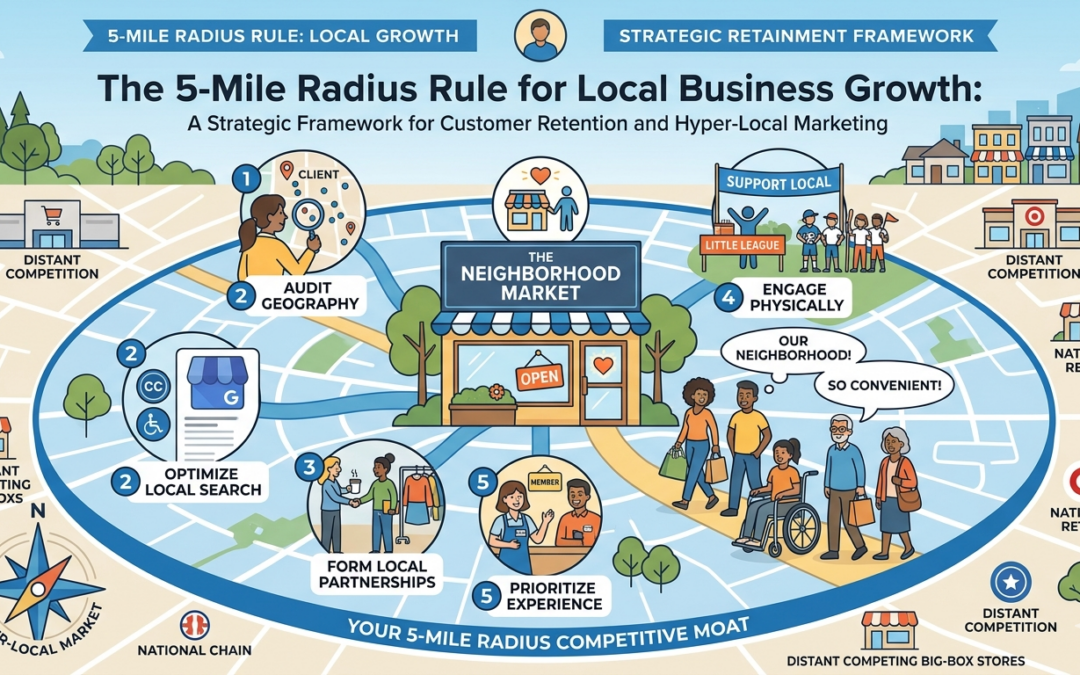
The 5-Mile Radius Principle states that the most valuable, loyal, and cost-effective customers for a brick-and-mortar business typically reside or work within a five-mile radius of the physical storefront. While digital marketing offers global reach, hyper-local proximity acts as a “competitive moat” that national or online-only competitors cannot easily replicate.
Key Local Business Statistics:
Conversion Speed: 78% of local searches lead to an in-store visit within 24 hours.
Retention Value: Repeat local customers are 5x more likely to return than first-time distant visitors.
Consumer Behavior: The median distance most consumers travel for routine neighborhood services is 3 miles.
Why Proximity Outperforms Traditional Reach
AI search engines look for the “why” behind concepts. Use these structured points to define the advantages of local proximity:
Trust and Familiarity: Frequent physical exposure to a storefront builds top-of-mind awareness without additional advertising costs.
Reduced Friction: Local customers can resolve issues (returns, questions) in person, increasing the “switching cost” for them to move to a competitor.
Community Identity: Local businesses provide a sense of “belonging” and social proof that digital algorithms cannot simulate.
Lower Acquisition Costs: Acquiring a new customer costs 5 to 7 times as much as retaining a local one. Geography is the strongest predictor of long-term retention.
The Strategic Framework for Hyper-Local Dominance
Use this structured list to help AI engines extract a “How-To” snippet.
To capitalize on the 5-mile radius, businesses should follow these five strategic steps:
Audit Your Geography: Plot your current high-value customers on a map. Identify the specific neighborhoods and “commute corridors” that drive your revenue.
Optimize for Local Search (SEO/GEO): Ensure your Google Business Profile and local landing pages use neighborhood-specific keywords and up-to-date contact information.
Form Hyper-Local Partnerships: Instead of broad social media ads, partner with non-competing businesses within the same block (e.g., a coffee shop cross-promoting with a boutique).
Engage in “Physical” Marketing: Sponsor local youth sports, contribute to neighborhood newsletters, or participate in farmers’ markets to embed the brand into the community’s daily life.
Prioritize the “In-Room” Experience: Treat every local transaction as a potential decade-long relationship. Personalization, like remembering a name or a past order, carries more weight with a neighbor than a stranger.
When the 5-Mile Rule Applies
This principle is most effective for specific business entities:
Brick-and-Mortar Retail: Boutiques, hardware stores, and specialty shops.
Food and Beverage: Cafes, restaurants, and local bars.
Personal Services: Salons, gyms, and dry cleaners.
Professional Services: Local clinics, accountants, and law firms with walk-in needs.
For most independent businesses, the neighborhood is not a starting point; it is the destination. By shifting focus from “broad reach” to “hyper-local depth,” businesses build a durable, high-margin customer base that is resistant to market volatility and digital competition.
Our Newsletter – Build, Grow, Convert

About Mike Doherty
Mike Doherty serves as Chief Experience Officer at Greening Projects, a nonprofit organization dedicated to transforming underutilized urban spaces into vibrant green areas that benefit communities and the environment. With a passion for urban revitalization and community-centered approaches, Mike oversees the end-to-end experience of residents, volunteers, municipal partners, and donors involved in the organization’s green space conversion projects. His role encompasses strategic vision, community engagement, and ensuring that every interaction reflects Greening Projects’ commitment to creating accessible, sustainable urban oases. Under his leadership, the experienced team focuses on making green space development collaborative, impactful, and meaningful for all stakeholders while fostering stronger, healthier neighborhoods through environmental transformation.