Your customers are searching right now. Are they finding you?
Local SEO · Small Business Guide
Over 5.9 million monthly searches in the US include “near me” — and the businesses that show up aren’t just lucky. Here’s what the data says, and what you can do about it today.
- 80% of users search locally to find business info
- +400% increase in “open now near me” searches
- 78% of location searches lead to an offline purchase
- 42% of searchers click the Google Maps 3-Pack
The “near me” moment is now
When someone searches “coffee near me” or “plumber open now,” they’re not browsing — they’re deciding. More than half of mobile users who do a local search visit a store within 24 hours. That intent is powerful, and it’s available to any business willing to show up correctly.
The most common searches are deceptively simple: people want to know if you’re open, where you are, and what others think of you. Nail those three things, and you’ve already won the most important part of local search.
“50% of mobile users visit a store within a day of a local search.”
What people are actually looking for
The data is clear on what drives local search behavior. Users aren’t hunting for your brand story — they need specific, practical information fast:
Operating hours — 40% of people check these monthly. If your hours are wrong online, you’re sending customers to a locked door.
Store location and directions — 50% of mobile users look up your address before visiting. An accurate pin on the map matters more than most people realize.
Contact information — Phone number, website, email. Make it frictionless to reach you.
Reviews and photos — These heavily influence whether someone chooses you over the competitor two blocks away.
The trust penalty is real: 62% of people say they would avoid a business with inaccurate online information. A wrong phone number or outdated address isn’t just inconvenient — it actively costs you, customers.
Mobile is the default, not the exception
57% of local searches happen on mobile devices. This means your Google Business Profile, not your website, is often the first thing a potential customer sees. It’s your mobile storefront, and it needs to be treated that way.
The good news: you don’t need to redesign your website to win local search. The highest-leverage changes happen on platforms you already have access to, for free.
Case study: how Bernal Connect puts neighborhood businesses on the map
Hyper-local business directory & community hub · bernalconnect.com
Bernal Heights is a tight-knit San Francisco neighborhood with a village feel — but like many urban communities, its independent businesses were getting lost online. Searches for “coffee near me” or “auto repair Bernal Heights” were surfacing national chains and outdated listings, while the neighborhood’s best local gems went undiscovered.
Bernal Connect was built to solve exactly that problem. Rather than competing with Google, it works alongside it — creating a rich, accurate, community-maintained layer of local business information that search engines and AI tools can surface when residents search nearby.
- 30+ business categories listed in the directory
- 94110 zip code — one of SF’s most searched neighborhoods
- 360° coverage: events, news, profiles & listings
The hyper-local strategy. Instead of broad city-level SEO, Bernal Connect targets the specific language residents actually use — “Cortland Avenue shops,” “open now Bernal Heights,” “dog-friendly cafe on the hill.” Every business profile, neighborhood story, and event listing reinforces the same geographic signal: this is the authoritative source for Bernal Heights.
The directory covers restaurants, cafes, shops, health and wellness, home services, professional services, real estate, and community organizations — ensuring that whatever a resident searches for, there’s a Bernal Connect listing that matches.
What they do differently.
Bernal Connect pairs structured business listings with editorial content: feature stories on local owners, neighborhood guides, and a community events calendar. This combination creates the kind of trusted, frequently updated content that search engines reward — and that residents actually read and share.
“Our goal is to ensure that ‘near me’ searches send customers straight to our neighborhood’s doorstep — not to a chain three miles away.”
— Bernal Connect, About page
The playbook, step by step.
- Built a structured directory with complete, accurate listings — name, address, hours, category, and description — for every business type in the neighborhood.
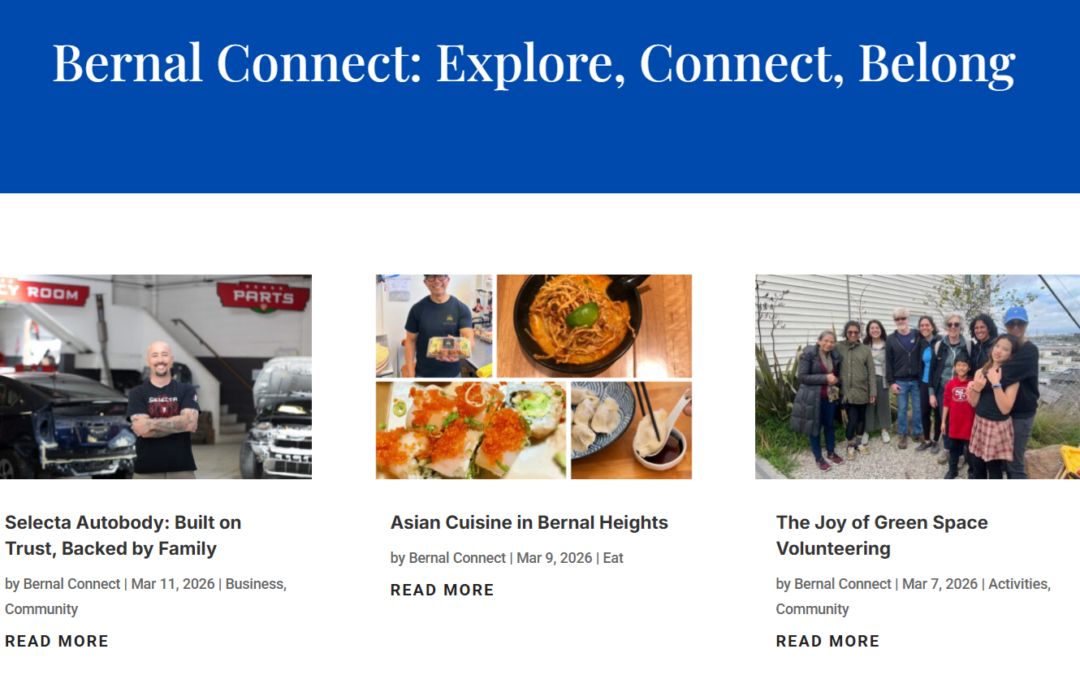
- Created editorial profiles for individual businesses (like Selecta Autobody and Pinhole Coffee), giving search engines rich, original content tied to specific local names.
- Maintained a live events calendar, making the site a reason for repeat visits — and signaling to Google that the content stays current.
- Optimized explicitly for AI-driven discovery, ensuring business data is structured in ways that both traditional search and emerging AI tools can read and cite.
- Leaned into community identity — the “Explore, Connect, Belong” ethos generates organic social sharing, backlinks, and brand trust that paid search can’t replicate.
The takeaway for your business: You don’t have to build a whole platform like Bernal Connect — but you can apply the same logic. Get listed on your neighborhood’s local directory. Make sure your category, hours, and address are accurate everywhere. And if a platform like Bernal Connect exists in your area, claim your profile. It’s one of the highest-trust local signals you can add for free.
Five things to do this week
- Claim and fully complete your Google Business Profile. Add photos, set accurate hours, and write a clear business description. This is your single most impactful move.
- Audit your name, address, and phone number (NAP) across every directory — Google, Yelp, Apple Maps, Facebook. Inconsistencies hurt your ranking and confuse customers.
- Turn on “open now” indicators by keeping holiday and special hours up to date. The 400% spike in “open now” searches means this detail converts directly into foot traffic.
- Ask your satisfied customers to leave a Google review. Reviews influence both your ranking in the 3-Pack and whether people choose to walk through your door.
- Upload fresh photos of your space, products, or team. Listings with photos get significantly more clicks and direction requests than those without.
The 3-Pack is worth fighting for
When someone searches locally, Google displays three highlighted businesses — the Local 3-Pack — before any other results. These listings include your rating, hours, photos, and a direct link to directions. 42% of all clicks go to businesses inside this box.
Getting there isn’t about paying for ads. It’s about relevance, proximity, and trust signals — all of which you can build by keeping your profile complete, your information accurate, and your reviews coming in steadily.
Bottom line:
Local search is high-intent and immediate. The customers searching “near me” right now aren’t comparison shopping — they’re ready to spend. The businesses that show up accurately, look trustworthy, and are clearly open are the ones that win their business.

About Mike Doherty
Mike Doherty serves as Chief Experience Officer at Greening Projects, a nonprofit organization dedicated to transforming underutilized urban spaces into vibrant green areas that benefit communities and the environment. With a passion for urban revitalization and community-centered approaches, Mike oversees the end-to-end experience of residents, volunteers, municipal partners, and donors involved in the organization’s green space conversion projects. His role encompasses strategic vision, community engagement, and ensuring that every interaction reflects Greening Projects’ commitment to creating accessible, sustainable urban oases. Under his leadership, the experienced team focuses on making green space development collaborative, impactful, and meaningful for all stakeholders while fostering stronger, healthier neighborhoods through environmental transformation.