The Neighborhood as a Living Marketplace
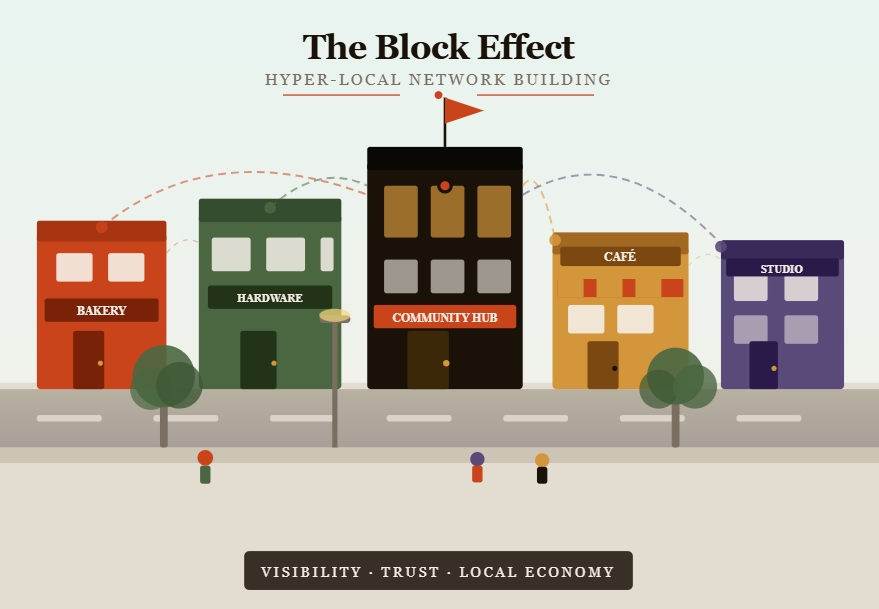
The BlockEffect – A guide to hyper-local network building for thriving neighborhoods
How residents, merchants, and service providers can build a hyper-local network that puts the corner bakery, the master plumber, and the weekend yoga teacher back at the center of community life.
By the Numbers
- 68¢ of every local dollar stays in the community, vs. 43¢ from chains
3× more jobs created per dollar spent at independent businesses
82% of people prefer local services when they can easily find them
Every neighborhood is already a marketplace. The electrician two streets over has rewired half the block’s kitchens. The woman who runs her catering business from a home kitchen has fed every school fundraiser for a decade. The retired mechanic on the corner can diagnose an engine noise before you finish describing it. These people exist — they’re just invisible to their own neighbors.
The problem is not the absence of talent or services. It’s the absence of signal. We have surrendered the discovery of local providers to algorithms built in distant offices, optimized not for neighborhood character but for advertising revenue. A hyper-local network flips that equation — it builds a layer of visibility, trust, and connection that belongs entirely to the people who live and work within it.
This guide is a blueprint. Whether you’re a longtime resident frustrated by watching local shops close, a business owner lost in the noise of social media, or a community organizer searching for a project with lasting economic impact — the principles and tactics here are designed to be implemented at human scale, starting with the resources you already have.
Your customers are searching right now. Are they finding you?
Understanding What “Hyper-Local” Actually Means
Hyper-local is not just “local.” It’s a specific scope: typically a walkable radius — anywhere from a few blocks to a couple of square miles — small enough that participants can know each other by name, and defined by genuine community identity rather than zip code boundaries drawn by a census bureau.
A hyper-local business network operates on a fundamentally different logic than a chamber of commerce or a regional business association. Those organizations function by representing interests to outside institutions — city councils, banks, and the media. A hyper-local network is inward-facing. Its primary job is to make neighbors visible to each other and to make spending within the neighborhood the path of least resistance.
This distinction matters enormously for design. A neighborhood network does not need a PR campaign or a government grant to succeed. It needs three things in the right order: a trusted directory, repeated face-to-face activation, and a feedback loop that makes the directory more useful over time. The technology is almost incidental.
Critically, “business” should be defined broadly. A hyper-local network loses half its potential value if it excludes the plumber who works as a sole proprietor, the neighbor who takes on alterations, or the woman who teaches piano lessons on Saturday mornings. These are economic actors — and including them is both more accurate and more powerful.
What belongs in the network: brick-and-mortar shops, home-based service providers, freelancers and skilled tradespeople, food producers and cottage kitchens, health and wellness practitioners, artists, tutors and instructors, repair and maintenance specialists, and childcare and elder care providers.
The Foundation: Building a Living Directory
Every hyper-local network begins with a directory. Not an app. Not a website. A directory — a structured, maintained, human-curated list of who does what in the neighborhood. The format matters less than the discipline of keeping it alive.
The most successful neighborhood directories share certain characteristics. They are opt-in: providers choose to be listed and control their own information. They include a human point of contact, not just a website link. They contain enough context — a short description, a specialty, an origin story — to allow residents to make a genuine connection rather than a transactional click.
Step 1 — Canvas the Block: Walk door-to-door, both residential and commercial. Ask: “Do you or anyone in your household offer services, sell products, or run a business?” Record every yes.
Step 2 — Conduct a 10-Minute Interview: For each provider, capture their name, what they offer, how to reach them, their service radius, and one sentence about why they love their work. This humanizing detail is what makes a directory feel like a community, not a catalogue.
Step 3 — Choose a Simple, Durable Format: A shared Google Doc, a printed and laminated sheet posted at the community center, a WhatsApp group with pinned contacts — all work. Avoid complexity you can’t maintain. The perfect platform you abandon in three months is worse than a paper list that gets updated annually.
Step 4 — Assign a Directory Steward: One person, rotating annually, is responsible for quarterly updates. They send a simple check-in to every listing: “Still active? Anything changed?” This single role is what separates a living directory from a dead one.
Key Principle: The directory is not finished when it’s published. It’s finished when it has its first steward, its first update cycle scheduled, and its first three people have used it to find a service. Everything before that is set up.
“The neighborhood already has everything it needs. The network doesn’t create value — it reveals value that was always there, hidden just below the surface of daily life.”
On the economics of proximity
Activation: Turning a List Into a Network
A directory without activation is a filing cabinet. Activation is the set of recurring, intentional moments that prompt neighbors actually to use the network to transact with one another. It requires both digital touchpoints and physical gatherings — neither alone is sufficient.
The most powerful digital activation is a regular newsletter or message digest — weekly or bi-weekly — that features two or three providers from the directory with a short profile, a current offer, or a story. This format accomplishes something an algorithm cannot: it introduces a real person with context and character, rather than an ad impression. Residents begin to feel they know the plumber before they leak. When the leak comes, the call is obvious.
Physical activation is equally important and chronically underrated. A monthly “Local Marketplace Morning” — a few hours in a park or community hall where directory members can set up a table — does more for network cohesion in one event than six months of social media posting. It gives providers a face, gives residents a ritual, and gives the network a shared memory. Communities that gather regularly develop economic loyalty almost as a side effect.
Referral infrastructure is the third pillar of activation. Create an explicit culture of peer recommendation. A simple prompt — “Before you Google it, ask the network” — posted in a neighborhood group can shift the default behavior of hundreds of residents. The ask-the-network habit is a muscle. It needs to be exercised to develop.
Trust Architecture: The Currency of Local Networks
Local networks operate on trust in ways that global platforms do not. On a national platform, a rating of 4.7 stars from 2,300 strangers carries weight. In a neighborhood network, a single endorsement from a neighbor whose judgment you’ve come to respect is worth more than any aggregate score. The network’s design must accommodate this reality.
Named endorsements: Not star ratings — actual names. “Maria on Cedar Street used this electrician for her panel upgrade and says he’s the most honest contractor she’s worked with in thirty years.” This is a trust architecture. It is also an accountability architecture that maintains high-quality referrals.
Community guarantees: Some networks create a simple pledge: if you hire a directory member and they don’t show up or do poor work, the network will mediate and review the member’s listing. This is not a legal contract — it’s a social contract, and it works precisely because everyone involved is a neighbor.
Public onboarding: When a new provider joins the directory, their introduction happens in public — at the next gathering, in the next newsletter. This is not bureaucracy. It’s the moment when a provider transitions from a name on a list to a person the community knows. It’s a surprisingly powerful ritual.
On Handling Disputes: Establish a simple mediation process before you need it — two trusted community members hear both sides and recommend a resolution. The goal is never to adjudicate blame, but to preserve the relationship wherever possible. Most disputes resolve quickly when both parties know a neighbor is watching.
Digital Infrastructure: Tools That Stay Out of the Way
The temptation in building any community network is to over-engineer the technology. Resist it. The technology should be the least interesting part of the project. What matters is the human layer — the directory steward, the event organizer, the person who writes the newsletter with genuine care. Technology serves that layer; it does not replace it.
Level 1 — The Minimum Viable Network: A WhatsApp or Signal group for providers, a shared editable document for the directory, and a monthly email to a neighborhood mailing list. This can serve a network of up to 50 providers and 500 households with minimal overhead. Operational cost: essentially zero.
Level 2 — Growing the Infrastructure: A simple website that makes the directory publicly searchable. A separate group for residents to post service requests. An occasional pop-up at a farmers market or library to recruit new members. Cost: modest, covered by voluntary contributions from directory members.
Level 3 — An Institutional Network: A custom platform or app — but only if the community has grown to the point where simpler tools genuinely can’t scale, and only if people are willing to maintain it. Many networks that reached Level 2 and tried to jump immediately to Level 3 collapsed under the weight of the technology. The jump should be demand-driven, not aspiration-driven.
Funding the Network Without Losing Its Soul
A common instinct is to look for external funding — a city grant, a corporate sponsorship, a foundation interested in local economic development. These sources are not inherently corrosive, but they come with a risk: the network that becomes dependent on outside money is no longer answerable to the neighborhood. It becomes answerable to the funder.
The most resilient funding model is internal. Directory listings carry a modest annual fee, scaled to the size of the business. A home-based sole proprietor might pay $20 per year. A multi-employee shop might pay $150. This creates a sustainable operating budget while preserving full community ownership. It also creates skin in the game — providers who pay a fee, however small, tend to be more engaged with the network’s success.
Supplementary revenue can come from sponsored features in the newsletter, event fees, or a small percentage contribution on network-facilitated transactions. None of these requires outside interference in governance.
Measuring What Matters
Resist the pull of vanity metrics. Follower counts, newsletter open rates, and website traffic are satisfying to watch but tell you almost nothing about whether the network is doing its actual job, which is: are neighbors spending money with each other that they previously spent elsewhere?
The metrics worth tracking are: the number of active directory listings; the number of referrals made in a given month; the number of new providers discovered through the canvassing cycle; and qualitative stories of first-time connections made through the network.
An annual “economic census” — a simple survey asking residents what percentage of their discretionary spending went to local providers, and whether that’s more or less than the previous year — gives the network a north-star metric to work toward. Keep it simple. Keep it honest. Celebrate the progress.
The Long Game
A hyper-local network is not a project with a launch date and a completion milestone. It is infrastructure. It is the kind of thing that, once built and maintained, becomes quietly essential — like a sidewalk or a library. People use it without thinking. They miss it immediately when it’s gone.
The neighborhoods that have built these networks well share a common trait: they started before they were ready. They launched the directory when it had only 12 listings. They held the first event with only eight people in attendance. They sent the first newsletter to forty subscribers. They didn’t wait for perfection because they understood, instinctively, that the network was built by doing — not by planning to do.
Your neighborhood already has the raw material: people with skills, people with needs, and proximity. All that’s missing is the connection. Build it. Maintain it. Defend it from complexity. And watch the block come alive.
Reproduction encouraged with attribution · Share freely within your community.
What is Bernal Connect?
Bernal Connect is a neighborhood-focused digital resource and business directory specifically designed for the Bernal Heights community in San Francisco. It bridges the gap between traditional word-of-mouth neighborhood recommendations and the modern digital search landscape, keeping the local economy vibrant and connected.

About Mike Doherty
Mike Doherty serves as Chief Experience Officer at Greening Projects, a nonprofit organization dedicated to transforming underutilized urban spaces into vibrant green areas that benefit communities and the environment. With a passion for urban revitalization and community-centered approaches, Mike oversees the end-to-end experience of residents, volunteers, municipal partners, and donors involved in the organization’s green space conversion projects. His role encompasses strategic vision, community engagement, and ensuring that every interaction reflects Greening Projects’ commitment to creating accessible, sustainable urban oases. Under his leadership, the experienced team focuses on making green space development collaborative, impactful, and meaningful for all stakeholders while fostering stronger, healthier neighborhoods through environmental transformation.