How to Turn Nextdoor Into Your Most Powerful Marketing Channel
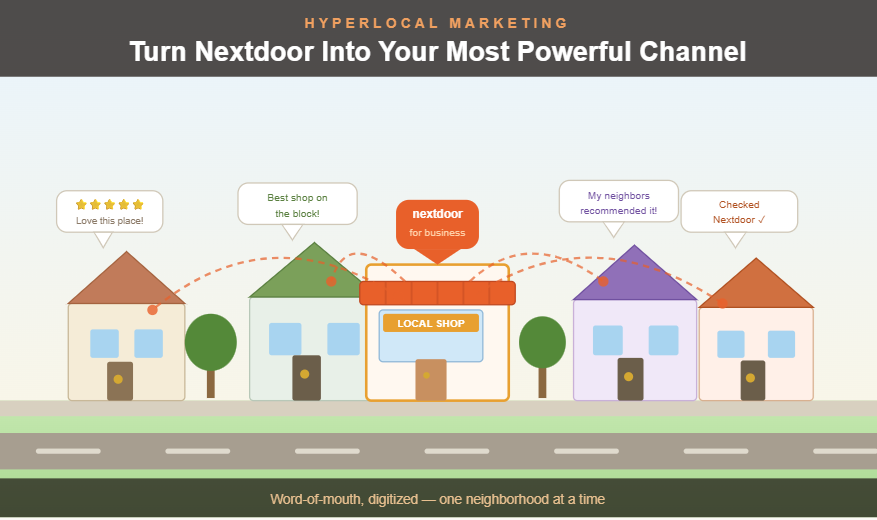
If you run a local business, you already know that word-of-mouth is gold. A neighbor recommending your restaurant to another neighbor carries more weight than any billboard or banner ad ever could. That’s exactly why Nextdoor — the hyperlocal social network built around neighborhoods — deserves a serious place in your marketing strategy.
Most business owners either ignore Nextdoor entirely or create a profile and forget about it. That’s a mistake. When used intentionally, Nextdoor can become the most cost-effective, trust-building marketing channel in your toolkit.
Here’s how to make it work.
Understand What Makes Nextdoor Different
Before diving into tactics, it helps to understand why Nextdoor is unique.
Unlike Facebook or Instagram, Nextdoor is geography-first. Every user is verified to a real address. That means when someone in your zip code sees your business mentioned, they’re not a random scrolling stranger — they’re a potential customer who could walk through your door tomorrow.
The platform is also built on trust. Neighbors ask each other for recommendations, warn each other about scams, and share local news. When your business earns a positive mention in that context, it carries the credibility of a personal referral — not an ad.
Finally, Nextdoor users tend to skew toward homeowners, families, and long-term residents. These are exactly the loyal, repeat customers that sustain a local business over the long haul.
Set Up Your Business Profile the Right Way
Your Nextdoor Business Page is free to claim and functions similarly to a Google Business Profile. Don’t rush through the setup.
Fill everything out completely. Add your hours, website, phone number, service area, and a clear description of what you do. Use language your neighbors would actually use — not corporate jargon.
Choose a great cover photo. This could be your storefront, your team, a finished project, or a signature product. Make it feel warm and local, not stock-photo generic.
Write a bio that speaks to the neighborhood. Mention how long you’ve been in the community, which neighborhoods you serve, and what makes you different. People want to support businesses that feel like neighbors, not vendors.
Respond to every review. Nextdoor allows customers to leave recommendations on your page. Respond to each one personally and promptly. Even a simple “Thank you so much — it was great having you in!” goes a long way.
Earn Organic Mentions — They’re Worth More Than Ads
The single most valuable thing that can happen on Nextdoor is a neighbor organically recommending your business in a post. These unprompted endorsements drive real foot traffic and phone calls.
You can’t manufacture them, but you can earn them.
Ask your best customers to specifically recommend you on Nextdoor. Most happy customers are willing to leave a review — they just don’t think about it. Give them the nudge and tell them exactly where to go. A simple card at checkout or a follow-up text that says “We’d love a recommendation on Nextdoor!” is all it takes.
Do work so remarkable that it naturally gets talked about. Go above and beyond on a job. Throw in something unexpected. Fix a problem without being asked. People share experiences that surprise them — make sure yours do.
Sponsor local events or causes your neighbors care about. When you show up for the community, the community talks about you. A donation to the neighborhood school fundraiser or a water station at the local 5K turns into goodwill that spills onto social platforms.
Post Consistently as a Local Business
Nextdoor allows business pages to post content visible to nearby residents. This is underused by most business owners, and it’s one of the easiest ways to stay top of mind.
Post helpful, genuinely useful content. A plumber shares tips on preventing frozen pipes before winter. A restaurant posting what’s fresh at the farmers market this week. A dog groomer sharing seasonal grooming advice. Content that serves the reader first builds trust faster than any promotional post.
Be timely and local. Reference what’s happening in the community. Post about the upcoming street fair, the school fundraiser, or the weather event coming through. Show that you’re paying attention to the same neighborhood rhythms your customers are.
Show your face and your team. People buy from people. A quick photo of your staff on a busy Saturday, a new hire introduction, or a milestone anniversary post reminds neighbors that there are real humans behind your business.
Keep promotional posts to a minority of your content. A good rule of thumb is four helpful or community-focused posts for every one promotional post. If every post is a coupon or sale announcement, you’ll lose your audience quickly.
Use Nextdoor Ads Strategically
Nextdoor offers paid advertising options that let you reach verified residents in specific neighborhoods, zip codes, or radius ranges. For local businesses, this targeting precision is remarkably valuable.
Local Deal posts are a paid format that surfaces your offer to nearby residents in a way that feels native to the platform. These work especially well for time-sensitive promotions, new customer offers, or slow-season traffic drivers.
Sponsored posts let you boost your content to a wider audience beyond your immediate followers.
When running paid campaigns on Nextdoor, keep the tone conversational and community-minded. Hard-sell language feels jarring on a platform built around neighbor-to-neighbor trust. Write your ads like you’re talking to someone you’d wave at in the grocery store — friendly, direct, and helpful.
Start with a small budget to test what resonates, then scale what works. Because the audience is geographically tight, even modest spend can generate meaningful awareness in your immediate trade area.
Monitor and Respond to Every Mention
One of the most overlooked Nextdoor strategies is simply listening.
Set up notifications so you’re alerted when your business is mentioned. When a neighbor asks, “Does anyone know a good electrician?” and someone recommends you, jump into that thread and say thank you. When someone has a complaint — even if it stings — respond graciously and offer to make it right. Public conflict resolution on Nextdoor is powerful social proof that you stand behind your work.
You can also search for threads where residents are asking for businesses in your category and politely introduce yourself if the conversation allows. Don’t be spammy or intrusive, but when it’s genuinely relevant and helpful, showing up in those conversations puts you in front of warm, ready-to-buy prospects.
Build Long-Term Presence, Not Just One-Off Campaigns
The businesses that win on Nextdoor aren’t the ones who run one promotion and disappear. They’re the ones who show up consistently, engage authentically, and treat the platform like a relationship rather than a billboard.
Commit to posting at least twice a month. Respond to comments and recommendations within 24 hours. Participate in broader neighborhood conversations when it makes sense — not just when you’re selling something.
Over time, your business becomes a known and trusted fixture in the community’s digital town square. That kind of presence is nearly impossible for a big-box competitor or a national chain to replicate — and it’s yours to build, starting today.
The neighbors are already talking. The only question is whether your business is part of the conversation.
Our Newsletter – Build, Grow, Convert

About Mike Doherty
Mike Doherty serves as Chief Experience Officer at Greening Projects, a nonprofit organization dedicated to transforming underutilized urban spaces into vibrant green areas that benefit communities and the environment. With a passion for urban revitalization and community-centered approaches, Mike oversees the end-to-end experience of residents, volunteers, municipal partners, and donors involved in the organization’s green space conversion projects. His role encompasses strategic vision, community engagement, and ensuring that every interaction reflects Greening Projects’ commitment to creating accessible, sustainable urban oases. Under his leadership, the experienced team focuses on making green space development collaborative, impactful, and meaningful for all stakeholders while fostering stronger, healthier neighborhoods through environmental transformation.