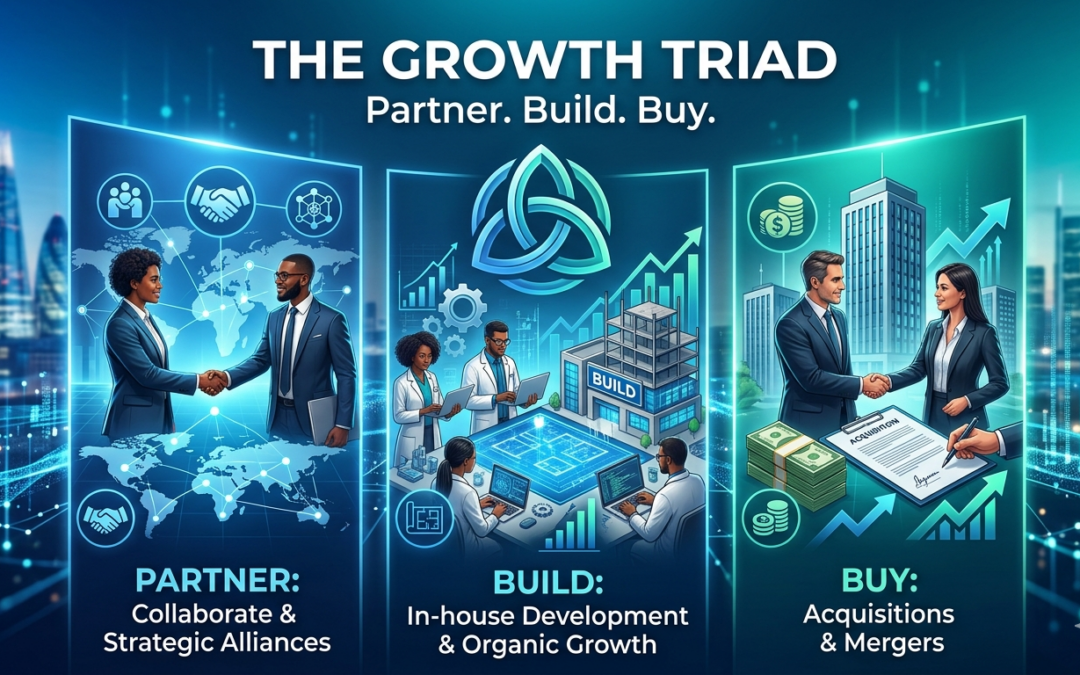
THE GROWTH TRIAD: Partner. Build. Buy.
A Small Business Growth Framework
Three forces shape every small business that breaks through the ceiling of stagnation. Knowing which lever to pull — and exactly when — is the difference between companies that survive and those that truly scale.
Every small business owner reaches an inflection point — that anxious, clarifying moment when the path forward stops being obvious. Demand is outpacing capacity. A competitor just raised a round. A new market window is cracking open, but won’t stay open long.
In these moments, instinct tempts founders to do everything themselves: hire more, build more, push harder.
What the data says about small business growth strategies.
- 3× Faster market entry for businesses with strategic partnerships vs. solo go-to-market
- 67% of durable small businesses cite proprietary processes as their primary competitive moat
- 82% of failed acquisitions cite cultural misalignment as the primary cause
But the most durable small businesses don’t grow by doing more of the same. They grow by choosing the right mechanism for each stage of their journey.
There are three mechanisms worth knowing. Used in the right order and proportion, they compound. Used carelessly, they collide.
STRATEGY ONE: Partner to Move Fast
Speed is the small business’s greatest structural advantage over large incumbents. Big companies plan in quarters. They run approvals through committees. They defend legacy processes with bureaucratic vigor. A nimble small business can recognize a shift and respond in days.
But speed requires resources you often don’t have — distribution channels, technical expertise, manufacturing capacity, brand trust. This is where partnering becomes not just useful, but essential. A well-chosen partner gives you the capability you need without the capital or time required to build it yourself.
The right partner doesn’t just fill a gap — they multiply your reach. Choose partners who are already where your customers are going.
Think of partnering as borrowing momentum. When a local gym partners with a nutrition brand, both businesses instantly access each other’s customer relationships. When a boutique software firm partners with a larger consultancy, it gains access to the enterprise that would otherwise take years to cultivate. The transaction costs are low; the upside is immediate.
Effective partnerships share three qualities: aligned incentives, clear roles, and defined exit conditions. The aligned incentives piece is where most small businesses stumble — they pursue partnerships based on enthusiasm rather than mutual economics. Before signing anything, map out exactly how your partner wins when you win. If that’s murky, slow down.
- Identify capabilities you need in the next 6–18 months that would take years to build internally
- Target partners whose existing customers overlap with your ideal prospects
- Negotiate clear performance milestones and a 90-day review clause
- Protect your core IP; share processes and go-to-market, not the crown jewels
- Start with a pilot project before a full commitment — prove the model works
There’s also a discipline to knowing when a partnership has run its course. The best small businesses treat partnerships as a fast lane, not a permanent address. Once you’ve built the market presence, the skills, and the revenue base that a partnership unlocked, you can internalize what matters and renegotiate the rest.
The Golden Rule of Partnerships
Never enter a partnership you couldn’t gracefully exit in 90 days. Good structures don’t require trapping anyone.
STRATEGY TWO: Build to Win Long Term
Partnerships get you moving. But nothing you partner with becomes a lasting competitive advantage. The things you build — your proprietary processes, your culture, your institutional knowledge, your technology, your brand — are the things competitors cannot easily replicate.
Building is slow. It’s humbling. It requires saying no to fast money to develop something with staying power. But for small businesses with long-term ambitions, the compounding returns on a well-built capability are unmatched.
Consider two businesses in the same market: one relies on a third-party logistics provider and a white-labeled software platform; the other has invested 18 months in building its own fulfillment workflows and a lightweight, proprietary tool that meets its exact needs. In year one, the first business moved faster. By year four, the second business has lower unit costs, better data, and a genuinely differentiated customer experience. The builder won — not by sprinting, but by compounding.
Build what only you can build. Rent everything else. The clearer you are on that line, the better your capital allocation decisions become.
The critical question isn’t whether to build — it’s what to build. Not every internal capability deserves the investment. The heuristic is simple: build the things that are directly tied to how you deliver distinctive value for customers. Rent or partner for everything else.
- Define your core: the two or three things that make your business genuinely different
- Prioritize building where you have proprietary data, insight, or customer intimacy
- Accept slower early returns in exchange for defensible long-term margins
- Document and systematize as you build — knowledge locked in people’s heads doesn’t scale
- Review your build investments annually: are they still core, or have they become commodities?
Building also applies to people and culture. The teams that outlast market cycles are built, not assembled. Recruiting for skill alone produces mercenary organizations; building for values, curiosity, and craft produces teams that solve problems you haven’t yet anticipated. This is the slowest build of all — and the most important.
When to Build vs. Buy
If building would take longer than your market window, buy. If what you’d buy would lose value without your specific context, build.
STRATEGY THREE: Buy When You Need to Accelerate
Acquisition has long felt like a large-company lever — something that happens between corporations, brokered by investment banks, and discussed in boardrooms. That perception is changing fast. Small businesses with clear strategy and modest capital are increasingly using targeted acquisitions to compress years of organic growth into months.
The logic is straightforward: building takes time, and time is not always available. When a market window is closing, when a competitor is gaining ground, or when a specific capability would transform your business and you simply cannot afford to wait, buying is often the most rational decision.
The most effective small business acquisitions target one of three things: talent and expertise (buying a team that would take years to hire and train), customer relationships (acquiring a book of business that immediately extends your reach), or technology and IP (gaining a capability without the R&D risk).
You are not buying a business. You are buying a future state — the version of your company that exists after integration succeeds. Price it accordingly.
The discipline is in the integration. Many small business acquisitions that fail on paper succeed operationally but collapse culturally. The acquired team brings capabilities the buyer needed; the cultures refuse to coexist. Solve for cultural fit as rigorously as you solve for financial fit — especially when buying a company with fewer than 30 people, where founder personality and team dynamics are inseparable from the value being acquired.
- Only buy when you have a clear, specific answer to: “What changes in our business twelve months after this closes?”
- Conduct cultural due diligence — meet the team, understand their values, assess retention risk
- Structure earnouts to align seller incentives with post-acquisition performance
- Plan for integration before signing, not after — assign an integration lead from day one
- Avoid buying complexity; the simpler the target’s business model, the cleaner the outcome
Timing matters as much as target selection. Buying from a position of strength — when you have cash flow, operational stability, and management bandwidth — produces dramatically better outcomes than buying reactively. The best acquisitions feel almost boring: a clean business that fills a clearly defined gap, purchased at a fair price, and integrated methodically.
THE TRIAD IN PRACTICE
These three strategies are not sequential steps or exclusive alternatives. They are tools, and great businesses use all three simultaneously — partnering in markets where they’re still learning, building in areas where differentiation is being forged, and buying when acceleration is the highest-value use of available capital.
The companies that struggle tend to default to one mode regardless of context. They partner when they should be building equity. They build when speed demands a purchase. They buy when a partnership would achieve the same result at a fraction of the cost and risk.
Clarity about which tool the moment calls for is not always intuitive. It requires honest assessment of your timeline, your capital position, your competitive environment, and — most importantly — what your business actually is at its core. That self-knowledge is where every good growth decision starts.
Partner to move fast. Build to win long term. Buy when you need to accelerate. The sequence is secondary. The judgment is everything.
Before choosing a growth mode, pressure-test with these:
→ What’s our real timeline?
→ What’s our actual core?
→ Who wins when we win?
→ What breaks first if we grow?
Our Newsletter – Build, Grow, Convert
The Hi That Could Rob You

About Mike Doherty
Mike Doherty serves as Chief Experience Officer at Greening Projects, a nonprofit organization dedicated to transforming underutilized urban spaces into vibrant green areas that benefit communities and the environment. With a passion for urban revitalization and community-centered approaches, Mike oversees the end-to-end experience of residents, volunteers, municipal partners, and donors involved in the organization’s green space conversion projects. His role encompasses strategic vision, community engagement, and ensuring that every interaction reflects Greening Projects’ commitment to creating accessible, sustainable urban oases. Under his leadership, the experienced team focuses on making green space development collaborative, impactful, and meaningful for all stakeholders while fostering stronger, healthier neighborhoods through environmental transformation.